What just happened
- The UK government hinted at softer Covid restrictions after case numbers fell by a third in the past month.
- Iran’s supreme leader blamed Israel for the assassination of the nuclear scientist Mohsen Fakhrizadeh.
- The CEO of Lime, the e-bike and e-scooter rental firm, said it was making a profit for the first time.
In normal times you’d expect a rich country to plan for and invest in the future. In the UK’s case that would mean spending heavily on artificial intelligence, because – all hype apart – this country is good at AI. Or at least it was. Now, compared with rivals, it’s slipping.
- Britain remains the world’s third AI powerhouse after the US and China but has fallen back over the past year in research, talent retention and other key indicators measured by the Tortoise AI Index. Israel, the Netherlands and South Korea have surged up the index’s international ranking.
- Brexit puts the UK’s position in further doubt: failure to reach a deal this month could leave the country’s AI sector behind a “data wall” preventing the free flow of personal data from the EU. As a spokesperson for London tech firms and investors put it: “If we crash out and there’s no subsequent agreement around data flows, AI, machine learning or data analytics, businesses are really going to suffer.”
- Public funding for AI research and infrastructure in the UK is dwarfed by what’s on offer across the Channel: Britain has earmarked £300 million as part of a five-year plan set out in 2018, compared with more than €4 billion committed by Germany for the 2018-24 period, and another €50 billion announced this year for a future-focussed tech fund to include investments in AI. France earmarked €1.5 billion for AI for the five-year period starting in 2018.
- Computing should be booming in British universities, but isn’t. UK institutions on the Times Higher Education’s list of top universities for Computer Science fell by an average of three places this year. The UK also slipped in supercomputer numbers, from 11 to 10 of the world’s biggest.
AI performance matters especially now. Artificial intelligence underpins all the high-tech, high-growth industries, from biotech to fintech, on which countries that have spent heavily to survive the pandemic will depend to recover. And few countries have spent as heavily, per capita, as the UK. Extra borrowing is at £400 billion and counting.
The irony. There was an AI evangelist in Number Ten – name of Dominic Cummings – but it’s not clear whether anyone left behind after his departure shares his enthusiasm.
The next superpower. The other big story from the first annual update of the Tortoise AI Index is China’s relentless rise as an AI behemoth. Against a maximum score of 100 for the US for 2019 and 2020, China climbed 10 points from 51 to 61 in the year. (The UK fell by eight, from 48 to 40. Israel, the Netherlands and South Korea gained five points each, to 36, 35 and 33 respectively.) Madeleine Albright, the former US Secretary of State, has highlighted China’s bid to set international AI standards as the international cutting edge of its “techno-authoritarianism”. Democracies, beware.
Don’t miss the Tortoise Global AI Summit on Thursday.
Rishi’s interests
When members of parliament take on ministerial roles, they become, rightly, subject to a greater degree of scrutiny. The ministerial code requires that those in public office declare any financial interests of their spouse and close family that might lead to a conflict of interest. But an investigation by the Guardian revealed that when he became chancellor, Rishi Sunak only added one of his wife’s financial ventures to his declaration – her ownership of a venture capital firm. Sunak’s wife Akshata Murty, the daughter of a wealthy Indian businessman, also has hundreds of millions of pounds of shares in the family company Infosys, a business that operates UK government contracts. A Treasury spokesperson said Sunak’s disclosures “followed the ministerial code to the letter”. What about the spirit?
Virus zappers latest
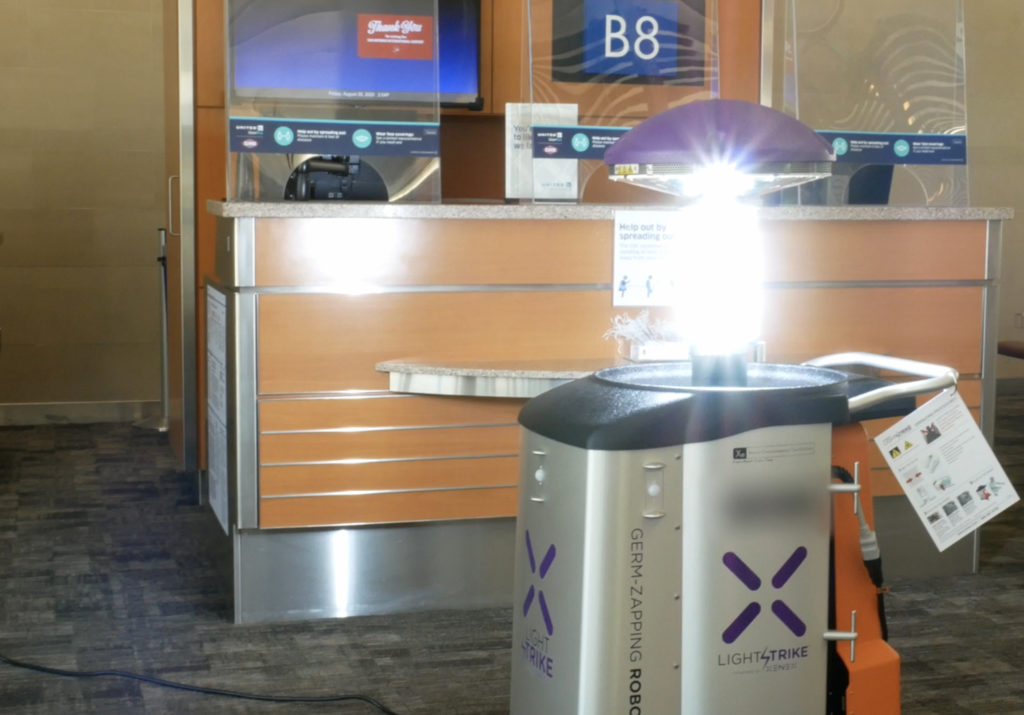
Last week we brought you news of a vase that doubles as a phone charger and disinfector, using UV light. In a similar vein it’s hard to resist the LightStrike virus-killing robot, deployed initially at San Antonio’s international airport. The maker of the robot, which is not really a robot in that it has to be pushed around by a human, claims it can destroy the coronavirus from seven feet, or about 2.5 metres, with high-intensity light pulses that mess with the virus’s DNA. It poses a risk to humans too, so can only be used when they are not in range. Unit price: $125,000. It will be interesting to see if this transitions quickly to the museum of quickly forgotten Covid tech, or becomes a familiar, blinding sight in public spaces.