What just happened
- Hong Kong intensified its purge of high-profile democrats, jailing Joshua Wong for 13 months and detaining the publisher of the liberal Apple Daily, Jimmy Lai.
- Giscard d’Estaing, the conservative moderniser who brought high speed trains to France in the 1970s, died aged 94.
- Stéphanie Frappart became the first woman referee of a Champions League football match, officiating at Juventus’ victory over Dynamo Kiev.
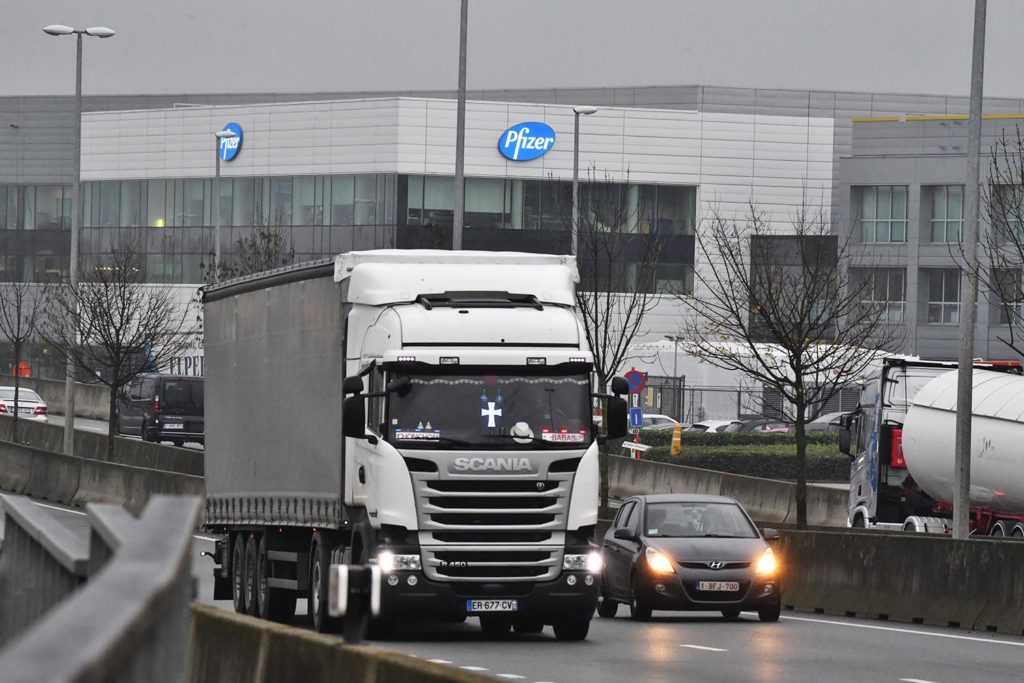
Starting at 7am next Monday, the first 800,000 doses of the Pfizer/BioNTech Covid vaccine to be released for public use will be administered to NHS health workers and elderly patients in 50 hospitals across the UK. The first patients to receive the vaccine will be those who already have hospital appointments for other reasons, and all recipients will be asked to return for a second dose 21 days later.
The vaccine is being distributed as an emergency measure after an accelerated rolling review of Pfizer/BioNTech data by the UK’s Medicines and Healthcare products Regulatory Agency (MHRA) – and the roll-out has been hailed by ministers not just as a world first but a sign of things to come for Brexit Britain.
So did Brexit speed this up? The short answer is no. June Raine, head of the MHRA, made clear she had “been able to authorise the supply of this vaccine using provisions under European law, which exist until 1 January”.
Will that end the argument? Not a chance. It will run and run. Matt Hancock, the health secretary, explicitly attributed the speed of the UK approval process to Brexit. So did Jacob Rees-Mogg, leader of the House of Commons, who said recent changes to UK regulations meant EU approval wasn’t needed.
In reality
- Both were wrong. When challenged, Rees-Mogg sent the BBC five lines of text from a memo attached to recent legislation that showed the quick approval would have been illegal but for the emergency process available to all EU member states.
- France, Germany, Italy and the other 24 member states all have their own equivalents of the MHRA that could have used this process but haven’t. Instead their governments are abiding by a collective EU decision to wait for approval from the European Medicines Agency, which has promised a decision by the end of the month.
- The EMA is spending longer poring over the data than the MHRA has, and the Food and Drug Administration in the US is, as usual, taking an even more laborious approach that leans less on the vaccine manufacturer and more on its own staff. The FDA expects to reach a view on the vaccine by 10 December.
So is the UK taking a risk? Probably not. Pre-Brexit, the MHRA was the EU’s medicines regulatory pace-setter. The EMA and member states were often happy to follow its lead because it scrutinised new products for the world’s biggest “single payer” healthcare provider, the NHS. The WSJ reports today that since the EMA – which used to be based in London – moved to Amsterdam, the MHRA has found itself with extra bandwidth which it was able to deploy reviewing the Pfizer/BioNTech data, working round the clock and sometimes sending back questions about the data within minutes of receiving it.
Even so, the EU has called the UK’s approach “hasty”. The EMA says its relative caution is more appropriate. Guido Rasi, a former EMA chief, says the UK hasn’t analysed all the data and is taking a risk not having done so “to be able to say that without Europe you come first”.
“Why is it so difficult to recognise this important step forward as a great international effort and success?” Andreas Michaelis, the German ambassador to London, asked on Twitter.
It’s a good question. Answers might include the Johnson government’s urgent need to change the subject after a backbench rebellion over its loathed tiered lockdown; an even more urgent need to curb the spread of Covid when as that lockdown is eased; and a miserable record of failure on every important front in the fight against the disease so far, from PPE to test and trace.
Next job: persuade the anti-vaxxers and the hesitant.
Slack attack
How could an office messaging system be worth $27 billion? Hmm. One answer is: sign up 130,000 paying customers and quadruple your annual revenue over two years, to $400 million. Another is: position yourself as a juicy acquisition for any emerging software giant hoping to take on Microsoft (and Microsoft Teams) in the age of working from home. Both apply to Slack, which is being bought by Salesforce, the cloud computing cumulonimbus, for $27.7 billion. The odd thing about this deal is that, compared with, say, Zoom, Slack hasn’t had a great pandemic. Its stock price has gone down as well as up since March. Ultimately, though, Salesforce is betting that work emails are history and Slack’s alternative – to help you create endless overlapping groups of colleagues and message everyone in them all at once with minimum effort – will fly.

Lab chicken
Forget vaccines. Today’s other big regulatory approval story is of lab-grown chicken, in Singapore. A US-based company called Eat Just has been cleared to sell artificial chicken nuggets in Singaporean restaurants, moving on in principle to retail sales after that. There seems to be an important distinction here between cultured meat, which is Eat Just’s speciality and involves proprietary chemical reactions in a lab, and plant-based meat alternatives, which are already big business for brands like Beyond Meat and Impossible Foods. Or maybe it isn’t important. Maybe the important thing is that no animals are dying and humans are still being fed.