What just happened
- The EU said the UK is breaking international law by unilaterally extending a grace period on border checks between Great Britain and Northern Ireland (more below).
- The US House of Representatives cancelled today’s session after police warned of a new threat from an “unidentified militia group”.
- CBS released a clip from Meghan Markle’s interview with Oprah Winfrey in which she accused the Royal Family of “perpetuating falsehoods” about her and her husband.
Non-UK readers, bear with us. Today is dust-settling-on-the-Budget day. But this is multibillion-pound dust and Britain is an interesting case study on:
- how – and whether – to go on paying people not to work;
- how – and whether – to keep pre-pandemic promises of regional investment; and
- how – and whether – to pay down the colossal debts incurred because of Covid.
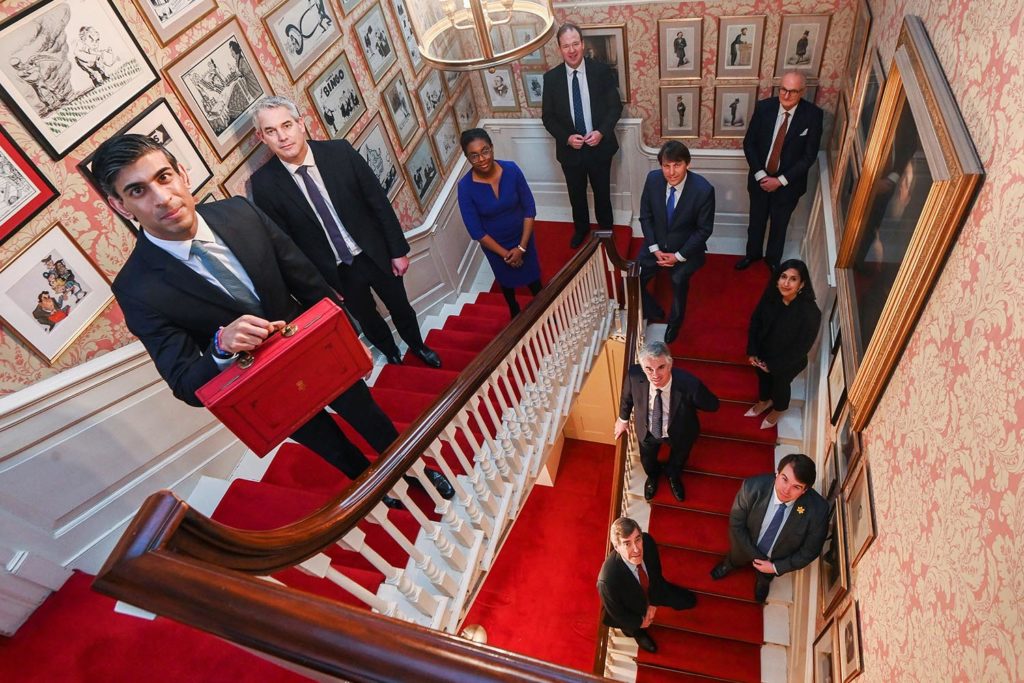
Rishi Sunak wants to be seen to do all this at once. To that end he confirmed he’ll go on paying workers to furlough till September at a cost of about £14 billion a month. As evidence that he’s still serious about “levelling up” (which worked well as an election slogan in 2019) he offered eight freeports, one new development bank and a 130 per cent business tax break for investors. And he announced the first corporation tax increase since 1974.
A few rump Thatcherites saw the tax increase as a betrayal but by and large the Conservative Party, the conservative papers and the people at large (in three snap polls) gave the chancellor high marks for walking the tightrope between fiscal prudence and crisis management in a pandemic.
One day on, what’s striking is what he left out:
- The NHS and social care. After a year of 24/7 emergency in the health service and catastrophic mortality in care homes, there was no new financial settlement for the NHS or state-funded social care.
- Young people. Unemployment will peak at 6.5 per cent later this year, which is remarkable considering 5 per cent unemployment used to be considered full employment, but there was nothing in this Budget for new entrants to a workforce that looks more capable of rehiring people it laid off in lockdown than actual job creation.
- Green growth. Boris Johnson has evinced sincerity about the need to build back greener but there was no mention of green jobs, carbon pricing or diesel scrappage and only a passing reference to carbon capture – as part of a Teesside redevelopment scheme.
- Any sense that this will hurt. Sunak had promised to level with the public and he did note there’d been no comparable borrowing since the world wars, but he promised there would be no increase in income tax, national insurance contributions, VAT or alcohol or fuel duty.
Sunak’s strategy for the country is to spend now and pay later. Sunak’s strategy for Sunak is to ooze confidence and compassion in relation to the immediate crisis while signalling to his party that he’s the kind of Tory who dreams of balancing the books – eventually. For now, it’s working. There’s scant evidence that freeports will work as investment magnets and plenty of evidence taxes will have to rise further to control debt. But Brand Rishi is a buy.
Now that’s a tax bill
US tax officials have filed their biggest ever tax fraud case against a software billionaire accused of hiding $2 billion from the Internal Revenue Service in offshore accounts in Bermuda, the Cayman Islands and elsewhere. Most of Robert Brockman’s tax evasion involved investments in a private equity firm founded by Robert Smith, the richest Black person in America, who wrote off an entire year’s student loans at his alma mater, Morehouse College, in 2019 and has since reached his own a settlement with the IRS. Brockman is 79 and, according to his lawyers, ailing. The WSJ reports ($) that one of his doctors has said Brockman is operating with short-term memory loss and an IQ of 87 – but prosecutors say the doctors have a conflict of interest because he’s donated generously to their medical school.

Rocket’s red flare
SpaceX wants to go to Mars in a distinctly retro stainless steel rocket that looks like one of the Thunderbirds’ international rescue vehicles. It’s called the Starship and yesterday, for the first time, a prototype flew high and landed in one piece – a trick long since perfected by the company’s much lighter workhorse Falcon 9 booster. But the Starship test ended with the rocket leaning slightly and on fire. After a few minutes it blew up. Elon Musk, the SpaceX founder, tweeted: “RIP SN10, honorable discharge”. The launch was from the company’s Boca Chica site in Texas on the Gulf of Mexico, where locals are divided. Some welcome the influx of money and jobs. Others detest the noise and frequent explosions in what was a bucolic wetland and a staging post for migratory birds.
Cut coal
There is no quicker way of cutting carbon emissions than by shutting down coal-fired power stations. We knew this, because the UK has cut overall emissions by 29 per cent by closing almost all its coal capacity in the past decade. It’s now the second-fastest cutter of emissions in the world – after Ukraine, which achieved a 4 per cent reduction last year compared with 3.6 for the UK, by the same method. The Times’s Ben Webster has the story. In truth its most significant stats show emissions increases in Russia, China and especially India (up 5.2 per cent last year alone), but at least they all know, as Lenin might have put it, what has to be done.

Brazilian reinfection
The Brazilian Covid variant known as P1 may be up to 2.2 times as transmissible as the original virus, according to a new study by Imperial College London. It also reinfected as many as six in ten people who already had antibodies from infection in the first wave of the pandemic in the Brazilian city of Manaus. P1 is on the march, with six cases confirmed in the UK and one of the carriers still not identified. The question is how well existing vaccines work against it, and Oxford’s Professor Christophe Fraser tells Sky we should be “a little bit concerned” that the variant might spread. Only a little? Well, there’s an emerging view that the Covid vaccines are an under-appreciated miracle that will virtually end hospitalisation and death from all variants even if they don’t yet stop transmission.
Irish loyalists
Loyalist paramilitary groups in Northern Ireland have temporarily withdrawn their support for the 1998 Good Friday agreement in a letter to Boris Johnson warning that a hard border in the Irish Sea “has no cross-community support and [is] therefore untenable”. There is no hard border there – only the customs checks on freight required by the EU to enable the UK mainland to be outside the single market while avoiding a hard border on the island of Ireland. And the loyalist groups have promised to keep things “peaceful and democratic”. Even so, the letter represents a stiffening of resolve on their part to resist the complex arrangement agreed between Johnson’s government and the EU to enable Brexit to happen on 1 January this year. That arrangement was already looking ragged after the UK’s decision to extend the grace period for customs checks without consulting the EU. This may get uglier before it gets resolved.
Thanks for reading, and do share this around.
Giles Whittell
@GWhittell
Photographs Getty Images, SpaceX