What just happened
- People still trying to leave Kabul were urged to stay away from the airport because of fears of an imminent terror attack.
- Spencer Elden, a 30-year-old man who as a naked baby appeared on the cover of Nirvana’s Nevermind, sued the surviving members of the band, alleging child pornography.
- A fire gutted The Elephant House, the cafe in Edinburgh where JK Rowling wrote early parts of the Harry Potter series.
Just because systems work for a while doesn’t mean when they break down they will be fixed. What applies to secular governance in Kabul and the broken under-the-counter bin in your kitchen applies equally to Britain’s supermarket supply chains.
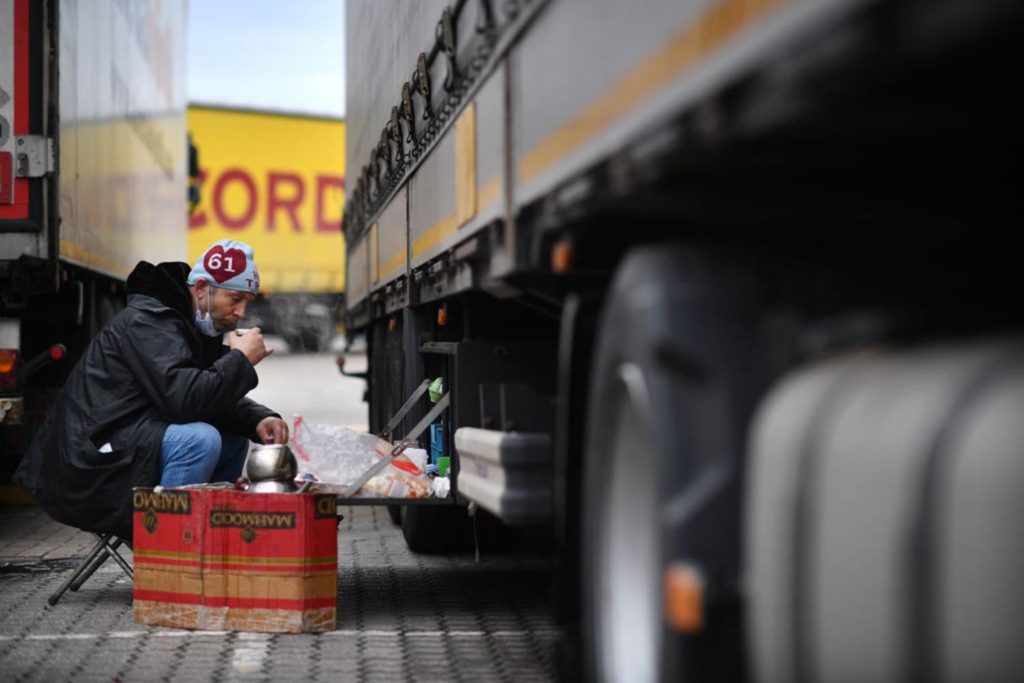
A shortage of about 100,000 lorry drivers has led to shelves emptying in Tesco, M&S, Asda and Iceland. Nando’s has had to temporarily close 50 branches. Greggs has reported delivery problems. All this may mean nothing to our non-UK readers but imagine if McDonald’s had no milkshakes. That is happening too.
It’s not a crisis. No one will go hungry because of it, much less lose weight. Christmas won’t be cancelled. But the great British supply chain screw-up is symptomatic, avoidable and – especially where the government’s response is concerned – embarrassing. It has three main causes:
- Covid. For a variety of reasons including Brexit (see below), 50,000 drivers left the profession last year – but were not replaced partly because the pandemic led to the cancellation of at least 30,000 Heavy Goods Vehicle (HGV) driving tests. Then this year’s “pingdemic” forced many drivers who were licensed to self-isolate for ten days at a time even if not ill. And some have called in sick feeling poorly after being jabbed.
- Tax. As of April, a new tax rule known as IR35 has meant agency drivers who used to take home £1,500 a week can no longer operate as freelancers, and are taking home much less. Employers are offering £1,000 to £1,500 signing bonuses for new drivers in an attempt to compensate, but it costs £3,500 to train for an HGV licence and anyway it’s hard to get a test (see above).
- Brexit. 14,000 European drivers left the UK last year alone and only 600 came back. For those who didn’t leave, the deadline to apply for residency passed in June. For those who did, it wouldn’t be possible to return even if they wanted to because lorry driving isn’t classed as skilled work and therefore visa-worthy under current immigration rules.
More visas? The most obvious solution and the one the CBI and the Road Haulage Association are imploring the government to adopt is to reclassify HGV driving as skilled work so that EU drivers can return.
Nope. More money. So far ministers have rejected the plea for more visas outright. They want higher wages and more investment in training for UK-based drivers and would-be drivers. It’s a test case. Stand firm, force employers to pay more, show that Brexit works for workers, the thinking goes.
The trouble is employers are already paying more and the driver shortage remains acute. CBI members report shortages of butchers, builders, engineers and IT people too.
Nonetheless a government spokesman tells the Times: “We have a highly resilient food supply chain. We have well-established ways of working with the food sector and are working closely with them to ensure businesses have the labour they need.”
Reality check. The UK food supply chain is not resilient. If it was, these shelves would not be bare. These “well-established ways of working with the food sector” are not well-established. They have been upended by Brexit and Covid. And businesses quite obviously do not have the labour they need.
We are where we are. The UK wants to import about half its food from Europe, but none of its lorry drivers. A new immigration regime is obviously needed post-Brexit, but government spokespeople would do well to stop pretending and start facing facts.
Vaccine diplomacy
Kamala Harris’s Asia swing is getting interesting. Yesterday we mentioned her delayed flight to Hanoi on account of the possible use of an acoustic weapon against a US official. That opened up a three-hour opportunity for China – and China pounced. Harris had a plan to donate one million doses of Pfizer vaccine to Vietnam, for a total of six million donated so far to the country it carpet bombed under Nixon. Beijing stole her thunder by sending its envoy in Hanoi to meet Vietnam’s prime minister and pledge two million doses. Pham Minh Chinh, the prime minister, said Vietnam “does not ally with one country to fight against another”. He doesn’t even seem to have played one off against the other. He didn’t have to. The US-Chinese rivalry in Asia, accentuated by the American debacle in Afghanistan, delivered the doses all by itself.
Face time
Ten US federal agencies are going to start using facial recognition technology to look for wrong-uns. They already use it to unlock employees’ phones and laptops in government buildings, but – the WaPo reports – the next step will be to install it in surveillance systems so that, for instance, an unwelcome intruder in a Department of Agriculture research site, or a face already on a watch list that shows up at a Veterans Affairs office, can be spotted automatically. No need for an old-fashioned security guard to keep an eye on the live CCTV feed. An interesting aspect of this story is that small tech stands to benefit and big tech wants to put the brakes on. Amazon stopped selling its facial recognition software to US police forces in May, citing a lack of regulatory oversight. Which presumably leaves a market opportunity for any firms less well-known and less concerned about a reality that mimics Enemy of the State.

Surf’s up, so’s Covid
Newquay has become the Covid capital of England. Public Health England data released yesterday shows Newquay East has 2,147 cases per 100,000 people and Newquay West has 1,648. It’s thought the Boardmasters surf/skate/music festival is partly to blame, with almost 5,000 cases linked so far to the event. That’s about one in 10 of the festival goers catching the virus. A general trend towards holidaymakers crowding in local honeypots in the absence of international travel has played its part too. Cornwall now has six of the eight top areas for infection in the country, with 4,439 cases reported in the seven days leading up to 20 August – a 1,015 increase on the week before. The Cornwall Chamber of Commerce says 30,000 more people have headed for its beaches this year compared with last. Although case numbers are up among the over 60s, most new cases are among 16 to 24 year olds. The question is, will the Newquay spike vanish as quickly as it appeared, as visitors go home?

Hot, hot, hot
Last year was Europe’s hottest on record, and not just by a bit. According to the American Meteorological Society’s 31st State of the Climate report, temperatures across the continent were 1.9 degrees Celsius above the average for 1981 to 2010. This was half a degree above the previous highest average temperature and higher than expected. It was also a year of record heat in Japan, Mexico and the Seychelles, and the seventh successive year in which temperatures in the Arctic exceeded the 1981 to 2010 average by a degree or more. Two thoughts: climate sceptics rightly note that much cautionary advice is based on projections. But actual measurements – of temperatures, carbon levels, polar ice melt, glacial retreat – are now routinely worse than the most mid-range projections. Second thought: if you can, take your children to see a glacier, but take the train.
Online sex re-rethink
OnlyFans has suspended its plans to ban sexually explicit photos from its platform. In an email sent to its one million content creators – many of them online sex workers – it said the proposed changes “are no longer required” thanks to assurances from its banking partners that the platform can “support all genres of creators”. On Tuesday, the company’s chief executive and co-founder Tim Stokely told the FT he had “no choice” but to ban porn from the site after pressure from his bankers. He blamed JP Morgan and Metro Bank, among others, for closing down sex workers’ accounts and refusing to process payments from the site. It’s not the first time the banking world and online porn have collided. Visa and Mastercard blocked payments on Pornhub last year after reports of videos showing child abuse and assault. Nor, in the end, is it all that surprising that a business model based on porn thinks twice about banning it.
The wheelchair basketball competition is in full swing in Tokyo. The event has been on the programme since the first official Paralympic Games in Rome 1960, when the first winners were the USA. The US men and women’s team are also the defending champions: the men beat the Spanish team in Rio 2016, while the women beat Germany. In fact the USA have dominated the competition, winning 12 golds since 1960 – way ahead of Canada who have won six.
Thanks for reading and do share this around.
Giles Whittell
@GWhittell
Produced by Sophia Sun and edited by Xavier Greenwood.