
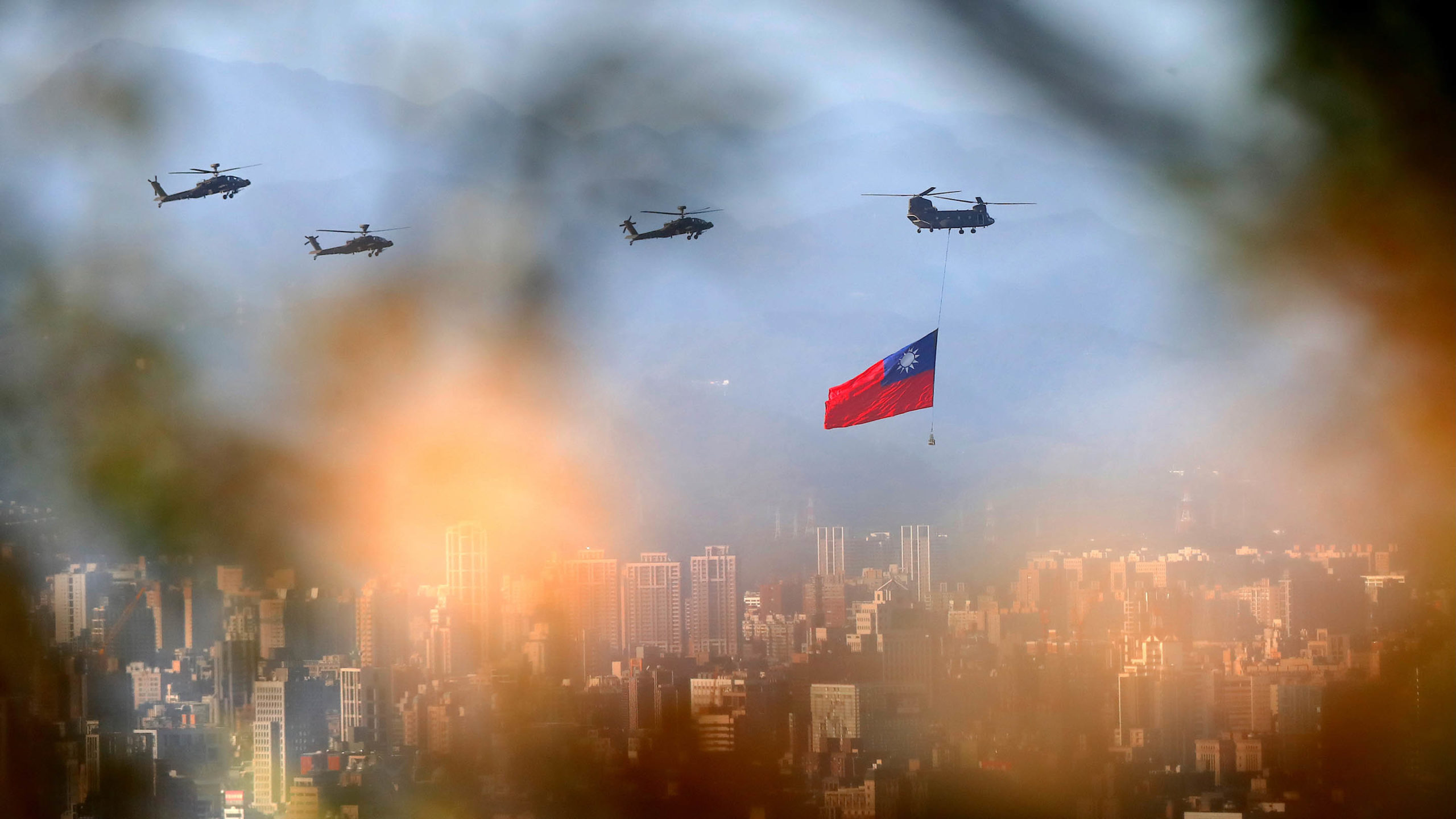
China’s current bellicosity ought to worry us all. There’s the possibility of war – and of the triumph of authoritarianism over democracy
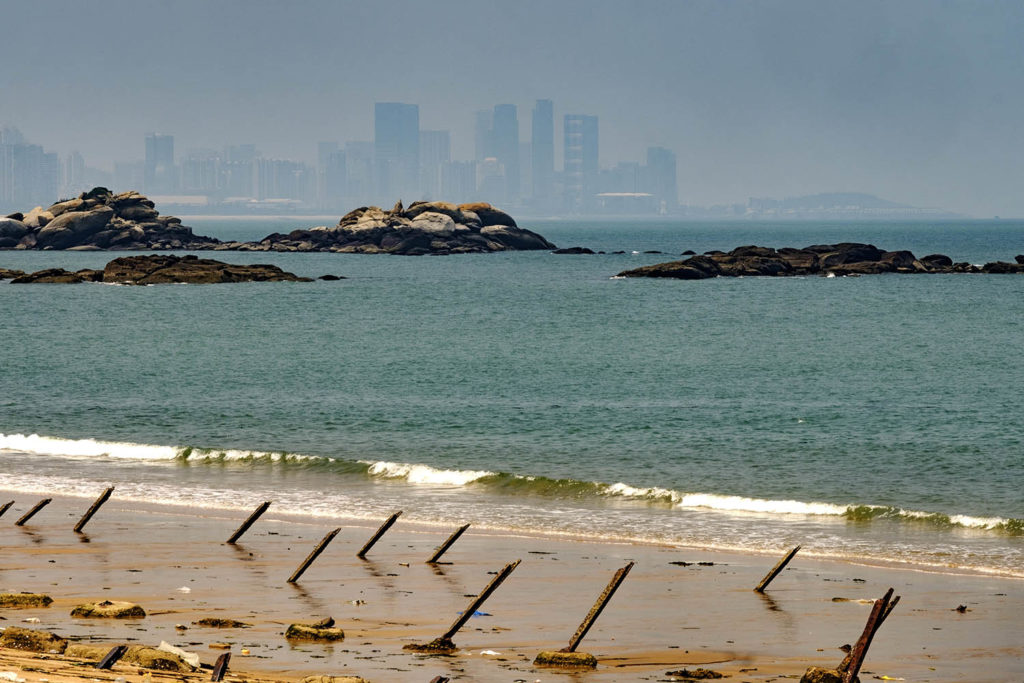
Try googling “Kinmen County”. Click on the map and use Street View to zero in on pretty much any beach that faces north or west. You should see a row of anti-invasion spikes sticking up and out to sea. These are relics of history but potentially useful too, because the Kinmen Islands are perhaps the most likely place on earth to host the start of World War Three.
The islands belong to Taiwan but are within swimming distance from mainland China. From there, starting a week ago, nearly 150 military planes flew into Taiwan’s Air Defence Identification Zone over the course of four days. There were fighters, submarine hunters and nuclear bombers. (I hesitate to mention this because it signals that this is a story for air nerds that needn’t concern anyone else, when it should really concern everyone.)
The planes didn’t enter Taiwan’s own airspace, but that wasn’t the point. They forced Taiwan to send up interceptors as part of what one expert tells me is a deliberate pattern of intimidation designed ultimately to persuade the Taiwanese people that resistance to the might of the Chinese military is futile.
Taiwan is a thriving democracy. It’s also an independent country. Everyone knows this, but amazingly few people in positions of power dare say it – because they’re all too scared of China.
Sixty years ago, Mao Zedong vowed to take Taiwan (“reunify China,” in Communist Party language), by force if necessary. Xi Jinping now styles himself more and more as Mao’s heir and has repeated the threat explicitly and often. Will he carry it out? No one knows, which considering the stakes is troubling.
So far, peace across the Taiwan Strait has been preserved by a game of bluff and doublespeak. China threatens force but doesn’t actually use it. Taiwan’s allies, chief among them the United States, refrain from recognising it as a real country or establishing full diplomatic relations, but they sell it weapons and promise support in an emergency.
Nothing about this game should be taken for granted. “The situation is enormously unstable,” says Professor Kerry Brown of Chatham House and King’s College, London. “It’s been kept stable only with constant vigilance for six decades. One misinterpretation of a signal from either side – that’s how wars start.”
Brown is too serious a person to talk lightly of world wars, but a conflict over Taiwan could escalate very quickly and there are at least seven reasons why one could start at any time.
First, there’s no formal trip-wire that everyone knows about. If Russia had been menacing Estonia as China has been Taiwan, every front page in the democratic world would have carried stories last weekend about Article 5 of Nato’s founding treaty, which states that an attack on any of its members will be considered an attack on all. There is no equivalent of Article 5 to focus minds and clarify consequences in the South China Sea.
Second, as self-appointed heir to Mao, Xi is boxing himself into a corner. He’s making promises to 1.3 billion people who may expect him to keep them. Like any authoritarian, he’s also surrounded by yes-people in a system that was already short of checks on his executive power. If he asks “should we invade?” it’s not clear there will be anyone within earshot brave enough to tell him not to be so stupid.
Third and fourth: Hong Kong. The lesson for Xi of the past two years has been that he can crush democracy in his own neighbourhood and suffer no serious repercussions. The lesson for Taiwan’s traditionally pro-China business lobby – which is substantial – is that while cosying up to Beijing may be immensely profitable it carries, in the end, too high a price. Hong Kong’s experience has in this respect unified Taiwan against China, ruling out the stealthy subversion of Taiwanese politics as a route to reunification. And that, as another expert notes, “kind of only leaves force”.
The fifth reason to worry is the Russian example. In 2008 in Georgia and in 2014 in Crimea and eastern Ukraine, Putin redrew international borders with impunity – and if he can, why can’t Xi?
The sixth is the example set by business. British Airways, Cathay Pacific, Air Canada, Marriott Hotels and dozens of other companies have caved to Chinese pressure to treat Taiwan as part of China as the price of operating on the mainland. Governments have, too. Only 17 of them officially recognise Taiwan and they are places like Palau and the Marshall Islands. It would take only a few more steps toward megalomania for Xi to think the world expected him to invade.
The seventh reason is chips. Taiwan is the world’s biggest manufacturer of semiconductors and control of its factories would give Beijing even more power over the world’s computing hardware and electric vehicle industries than it already enjoys.
Xi and President Biden had a phone call this week. Afterwards, Biden said they’d agreed to abide by the “Taiwan agreement”. Yet there is no agreement – only an informal understanding that for China to invade Taiwan, or for Taiwan to declare independence, or for one of its major allies to recognise it as an independent country, would be to cross a red line.
There is a horrible imbalance here. Taiwan and its allies refrain from doing something that makes perfect sense and acknowledges reality. In return, China refrains from doing something that is plainly abhorrent and violates every international norm.
This is not fair, but it’s worse than that, as Taiwan’s brave and patient President Tsai Ing-Wen points out in the latest issue of Foreign Affairs. “If Taiwan were to fall,” she writes, “the consequences would be catastrophic for regional peace and the democratic alliance system. It would signal that in today’s global contest of values, authoritarianism has the upper hand over democracy.”
The truth is authoritarianism already does. Tsai’s message is that this is not acceptable as a status quo, and if her fellow democrats abroad don’t stir themselves to change it, her fellow democrats at home just might. Her vice president is much more strident than she is about the need to declare formal independence, and might do it if he ever landed the top job.
As things stand, from Beijing’s point of view, that would justify invasion. What then? WEPTO, anyone? The Western Pacific Treaty Organisation. It has a certain ring to it. Unlike the newly minted AUKUS, it would not pointlessly exclude Japan, South Korea and the EU. It would show China that the democratic world was united against its bullying of Taiwan and saw its claims for what they are. Which is to say, entirely bogus.
Remember: there is no Taiwanese equivalent of the treaty between China and the UK that governed the administration of Hong Kong and expired in 1997. Beijing simply asserts a claim over Taiwan as a jewel thief might over a necklace. And now we learn that the US has been sending special forces to Taiwan to help train its frontline forces, but can’t admit it. Putting aside the usual sensitivities about revealing the use of special forces, the situation is absurd. The world’s most powerful democracy cannot own up to helping a democracy in need, for fear of offending a dictatorship.
We need a tripwire in the Taiwan Strait, but we need more than that. We need a collective acknowledgement that what’s at stake is how the world is run.
Photograph by Ceng Shou Yi/NurPhoto via Getty Images