

It’s tempting to believe the solution to cutting soaring energy bills is lying beneath our feet. But after a decade dreaming of a US-style shale revolution, fracking has failed to deliver.
Britain’s fracking industry is having a last hurrah. Plans to concrete over two of the country’s few viable shale gas wells were left in doubt this week after Kwasi Kwarteng, the business secretary, told the Commons “it didn’t necessarily make any sense”. At the same time, Boris Johnson has tasked advisors with taking a fresh look at whether fracking could help the UK achieve energy independence from Russia.
The argument for lifting a 2019 moratorium on fracking is this: there’s now no doubt that energy security equals national security, and proponents say a fracking free-for-all could produce enough natural gas to meet around a fifth of projected UK gas demand between 2020 and 2050. The UK Onshore Oil and Gas (UKOOG) lobby group says drilling 4,000 wells by 2032 would provide 65,000 jobs, a tax take of £200 billion, and another way to level up the North. A UKOOG spokesperson quotes a Liverpool University study that found the largest fracking-caused tremor in the UK had the “surface vibration equivalent of dropping a honeydew melon”.
It’s tempting to believe the solution to cutting soaring energy bills (see below) is lying beneath our feet. But after a decade dreaming of a US-style shale revolution, familiar hurdles remain:
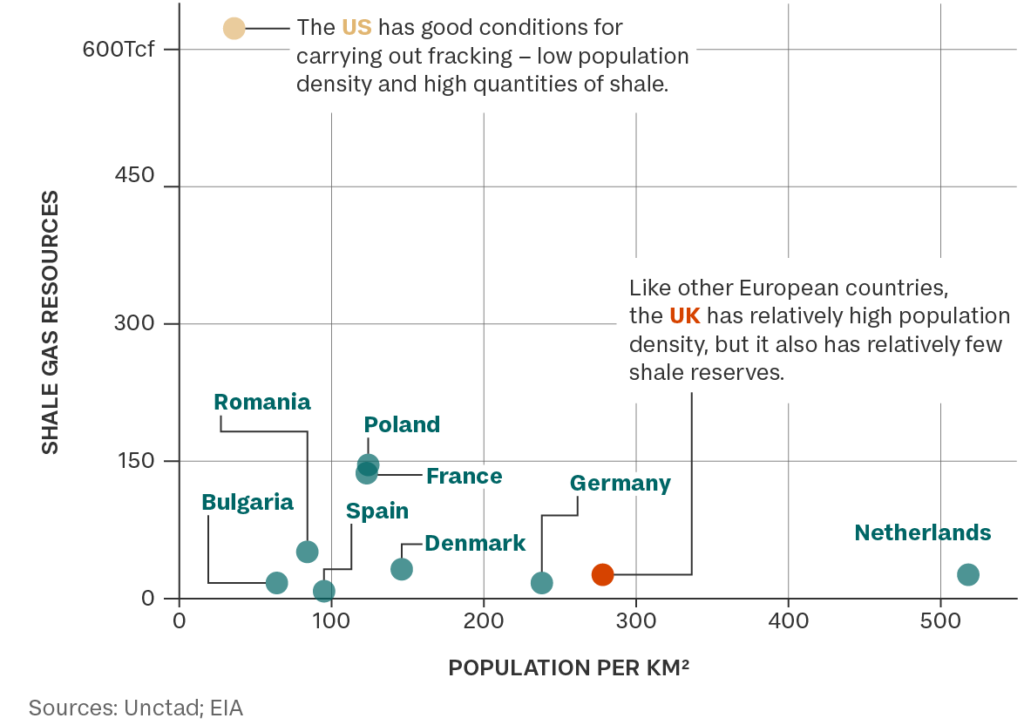
- Lancashire isn’t Texas. “The geology of the UK is no good for fracking and commercial shale gas,” says Stuart Haszeldine of the University of Edinburgh. “There are too many geological faults. In the US, the shale is stacked like books. It’s much simpler and safer.” Another key difference is that US landowners own the rights to natural resources on their land, while in the UK they are Crown property. Nimbys are few in the Permian Basin in the American southwest, with a population density of 16 people per square mile. In Lancashire it’s close to 500. UK anti-frack activists are well organised and generally represent the views of the public: a poll last autumn found 45 per cent were against fracking while 17 per cent were in favour. To note: Rishi Sunak, whose constituency is located near shale deposits in North Yorkshire, has avoided taking a stance on fracking. Liz Truss and Robert Jenrick are among those voicing support.
- The commercial test-case has failed. Cuadrilla Resources, the company that pioneered the first major UK shale gas discovery in 2011, was able to produce 275,000 cubic feet of gas per day at peak flow from its wells. That’s enough to supply just 150 houses year-round. After eight years of engineering experiments – and a 2.9 magnitude tremor – Cuadrilla’s owners were told by the Oil and Gas Authority to plug the wells at Preston New Road, and they’re now considering new uses for the site. Other firms have already moved on: “Fracking is no longer our business model,” says Steve Mason, Director at Third Energy, a company which holds seven licences for onshore exploration in the UK. “We’re a renewable energy company now.”
- It won’t ease the pain next winter. Even in the industry’s best case scenario – including a swift end to the moratorium and zero planning issues or protests – fracking would meet less than 5 per cent of UK gas demand over the next 5 years, according to analysis by Carbon Brief. Drilling a borehole takes around two months but sourcing the specialist labour required to drill between 10,000 and 40,000 of them is a huge undertaking. The government would also need to drastically relax planning rules – something Kwarteng has already decided to do for wind farms.
- The global market. There is no reason why UK gas producers would sell shale to consumers below the market price. As the business secretary said, “they’re not charities”. Even in the US, where shale evangelists are many, there is scepticism that the industry can sate a growing global appetite for non-Russian oil and gas. “The only sizeable offsets to the loss of Russian exports are OPEC+ spare capacity, the potential return of Iran’s exports, strategic stock releases, and possibly some Venezuela production if sanctions were eased,” says Bob McNally, President of Rapidan Energy Group. However, US liquified natural gas supply will pick up from next year, and could be a big part of the solution to Europe’s energy crisis.
All things considered, fracking is unlikely to get the green light in Johnson’s emergency energy strategy, which is due to be published within a fortnight. Keeping the UK on track to meet its net zero target will require unabated fossil gas combustion to fall 65 per cent by 2035 and 99 per cent by 2050, according to the Committee on Climate Change. Briefings from BEIS suggest the government wants to stick to that goal, with an emphasis on wind expansion, a trebling of solar in the next eight years and more back-up nuclear. During previous energy shocks – Suez, the 1970s, the Gulf War – the knee-jerk solution has been to drill. This time it’s different.