
The Democratic Republic of Congo's decision to sell forest to oil companies is part of a wider African push into fossil fuels. But who's buying?
One of the most carbon-dense places on the planet is up for sale to oil companies. Last month the government of the Democratic Republic of Congo announced it would be auctioning off 27 tracts of pristine rainforest and tropical peatland for drilling and exploration.
Scientists say allowing it to go ahead would be a disaster. Up to 5.8 billion tons of carbon locked in concession areas could end up in the atmosphere, while unmanaged wastewater from oil production has the potential to poison people and wildlife.
The case made by Kinshasa is that it should be able to use the DRC’s natural resources to develop the country and provide a secure energy supply – just like the rest of the world. DRC’s per capita emissions were 141 times lower than the UK’s in 2019 and 60 million people in the country live on less than $2 a day.
But for the auction to be a success, the DRC first needs some willing buyers.
Since the bidding opened, household names in the oil industry have been ruling themselves out. TotalEnergies and Eni, two European companies active in Africa, have said they won’t bid. Tortoise understands that Chevron has done the same. A spokesperson from Perenco, an Anglo-French company with existing operations in the DRC, did not explicitly rule out a bid, but said:
“We would study with attention all proposals made by the Ministry of Hydrocarbon in terms of new exploration acreage. We will support… oil and gas development in the country, as we always do in countries where we operate.”
Why, when prices and demand for oil are high, would majors be passing up on an opportunity to access reserves worth an estimated total of more than $650 billion? Reputational risk, high upfront costs, and ongoing conflict in parts of the DRC all have a part to play. So what’s going to happen when Big Oil bows out? There are a few options:
- The backdoor. A source with in-depth knowledge of the oil sector in the DRC says unknown Congolese companies, recently incorporated for the purposes of the tender, might act as “facilitators” for foreign investors bringing the necessary wealth and exploration expertise.
- China. “If they [Western companies] all say we are not getting involved, what do you think the country is going to do?” asks NJ Ayuk, Executive Chairman of the African Energy Chamber. “The country is going to have to turn to the Chinese. They’re going to have to turn to companies that don’t have the ESG credentials and really don’t care.” According to the industry source, South Africa’s Efora Energy Ltd, Malaysia’s Petronas and even Russian companies may also consider bids.
- Carbon credits. Didier Budimbu, the DRC’s hydrocarbons minister, told the FT he would accept bids for exploration rights from carbon market start-ups as long as they had solid financial backing. RedemptionDAO, a campaign group that started on Telegram, hopes to raise at least $50m to buy at least one block before dividing it up into carbon credits of “avoided emissions”.
- Western intervention. More could be done to encourage the DRC to keep its forests standing. Since DRC President Félix Tshisekedi and Boris Johnson signed a 10-year agreement at Cop26 to protect the Congo Basin rainforest, less than half of the $500 million pledged under the Central African Forest Initiative has been transferred to projects in recipient countries. On a trip to the DRC this month, US Secretary of State Anthony Blinken said American and Congolese officials would form a team to examine the impact of extraction from the 27 blocks. But is it too late?
The timing of the DRC auction, which closes in February, is pertinent. Cop27 is less than three months away and the negotiating lines are being drawn. It’s happening in Egypt, on African soil, and African nations are rightly seizing it as an opportunity to have their voices heard on climate and energy.
African economies dependent on fossil fuel revenues are already insisting that the right to use domestic reserves, especially gas, stays on the table. Last week the African Union published a report calling for more investment in gas projects. Adesina Akinwumi, the president of the African Development Bank, has called it the “fundamental energy source in Africa”.
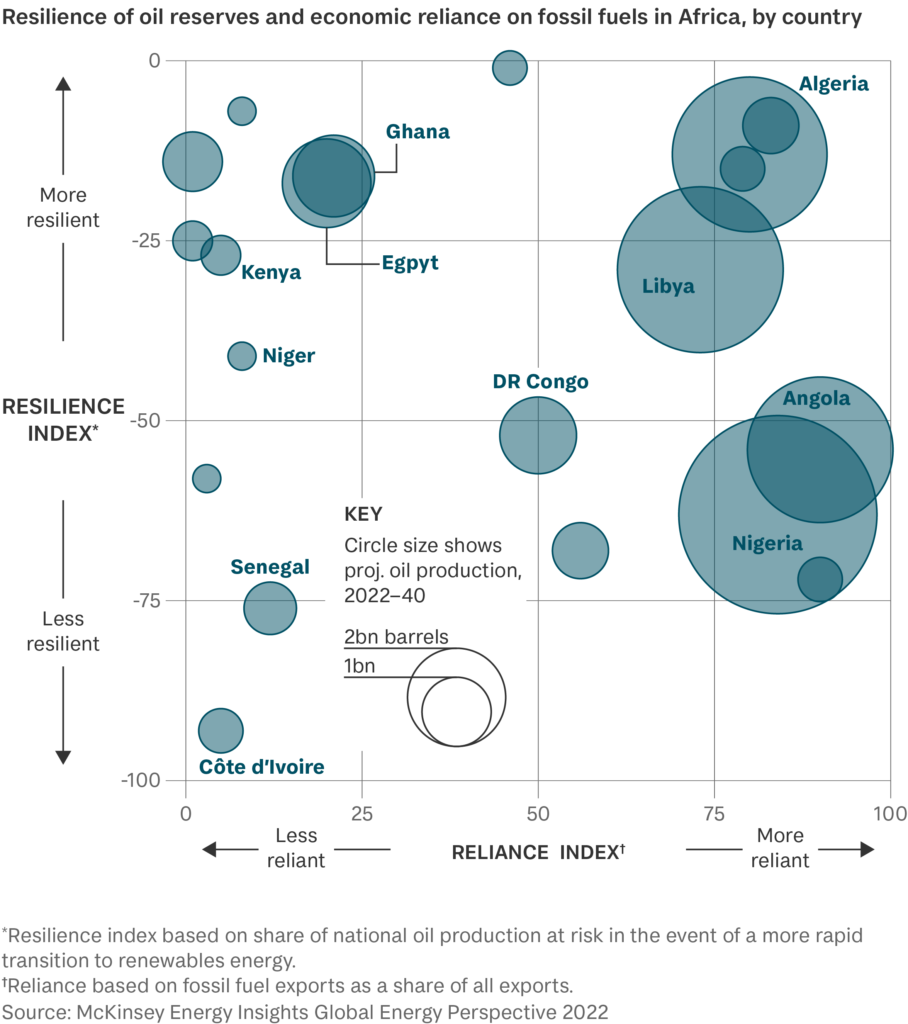
This leaves Europe in a tricky position: how can it argue that Africa should transition faster while at the same time buying up spare gas wherever it can? “They turn around and tell us that we should not use clean gas, even when the EU taxonomy describes it as green,” Ayuk says. “That’s something that for us is very frustrating.”
But activists are also frustrated. They’re asking why the continent hardest hit by the climate crisis, with high renewable energy potential, is now committing to a fossil-fueled future.
Africa’s energy demand could grow as much as 30 per cent by 2040 and energy security is a legitimate concern. But leaders can’t allow price-gouging on global oil and gas markets to dictate policy. Distributed renewables present the best way to improve livelihoods across the continent. As for the DRC’s rainforest, that too presents an economic opportunity. It’s up to the world, not just the DRC, to realise that value.
Further reading: the DRC’s other great untapped energy source is the Congo River.
China’s heatwave
Can’t sleep? In some of the places hit hardest by China’s 70-days-and-counting heatwave night-time temperatures aren’t falling below 34C. This week the province of Beibei hit 45C for two consecutive days. The cities of Chongqing and Chengdu in the south-west have ordered outdoor lighting displays to be turned off to save energy, while office workers have been urged to set their air conditioners to 27C. China’s worst drought in 60 years is compounding the problem: hydroelectric power resources are down 51 per cent, which in turn is cutting power supplies to China’s key industrial hub of Sichuan. The extreme heat is expected to last until the end of the month.
Kwarteng’s in-tray
On Friday, the UK’s energy regulator Ofgem will announce its October price cap. It’s expected to rise to over £3000 with analysts predicting that figure will double by next April. For the next leader of the Conservative Party there is no avoiding the size of the crisis waiting. Both candidates have firmly ruled out a complete freeze on the cap. Instead, business secretary Kwasi Kwarteng – bookies favourite for chancellor in a Liz Truss cabinet – has another plan to reduce bills. Kwarteng is preparing to cut the “crazy” profits of renewable energy firms and offer a fixed-term rate. The logic being that the market currently allows for cheap renewables to be sold at higher wholesale prices in line with inflating gas prices. Bring down renewable prices, bring down the rate of inflation. It’s a move in line with wider reforms of the electricity market being reviewed and consulted on by his department.
Going for broke
The potential loss of a million animal and plant species due to climate change presents a major economic risk. Reduced fish stocks, tropical timber, and wild pollination are instances of failing “ecosystem services” caused by the loss of biodiversity. Researchers in Cambridge have created a new sovereign credit rating system to account for such risks. The picture they paint is bleak; downgraded ratings, spiralling borrowing costs and sovereign debt default – for low and high GDP countries alike. Half of the 26 countries examined in a 2021 report from the World Bank increased their risk of bankruptcy in excess of 10 per cent under a “partial ecosystems collapse” scenario. It is becoming clear that, as author Professor Ulrich Volz notes, “protecting the natural habitat is not just important for nature’s sake but also crucial for safeguarding macroeconomic stability”.
Qanat stand the heat
The city of Seville is spending €5 million on a project to replicate the ancient Persian technology of qanats in order bring down temperatures on the street. Qanat systems, developed over 1,000 years ago, consist of underground canals that carry water across a large area. Vertical shafts along the canal then take air upwards to the surface, lowering temperatures above ground by as much as 3C. The CartujaQanat project is scheduled to be completed in October and will use renewable energy to keep the canal water running. Seville is also the first city in the world to start naming and ranking heatwaves based on projected health outcomes. Each tier of heat warning triggers a different level of emergency response effort, such as opening cooling centres and sending community health teams to check on high-risk populations.
Thanks for reading.
Barney Macintyre
Additional reporting by Phoebe Davis. Edited by Giles Whittell.
With thanks to our coalition members: a network of organisations similarly committed to achieving Net Zero