


Poor regulation is partly to blame for the astronomical energy bills Brits are facing this winter. It's time for a rethink on energy policy.
When energy company Bulb became the UK’s sixth-biggest supplier on a promise to cut bills and emissions, it seemed a vindication of the government’s efforts to shake up a market dominated by six giant companies.
Promising to supply renewable electricity to every member and to offset its gas, Bulb, a company founded by a management consultant and a former energy trader, grew rapidly to supply 1.7m customers.
The rise in wholesale energy prices is the main culprit for the astronomical bills facing British households this winter, but chaotic regulation also has a role to play in this story, as Bulb’s downfall illustrates.
The collapse of 28 UK energy suppliers since summer 2021 is calculated to have added an additional £94 to each household’s bill, as suppliers who have taken on stranded customers pass on additional costs.
The bailout of Bulb is expected to be the most expensive since RBS was rescued during the financial crisis, though in this case the government is expected to recoup the cost out of consumers’ bills rather than taxes.
Bulb’s collapse will add another £150 to every household’s bills next year according to a prediction by energy consultancy Auxilione.
Was this avoidable? Last November, Bulb went into ‘special administration’ because its customer base was thought to be too large to immediately offload onto another company. After that the company’s administrators, Teneo, had a choice: they could buy energy in advance – a form of hedging – or they could opt for a pay as you go approach.
Expecting that wholesale gas prices would go through the roof – they’re now at ten times normal levels for this time of year – Teneo asked the government for cash to hedge. The government said no.
Alan Brown, SNP MP and member of the BEIS select committee, says: “The Treasury was thinking ‘how can we pay out as little as we can’. They didn’t look at the long-term consequences of not hedging… It’s a matter the select committee may need to revisit.”
A July review of the energy market by the BEIS select committee found that Ofgem has proved “incompetent” as the regulator over the past decade.
The government’s continued support of Bulb is expected to cost up to £4 billion. Sale of the company could, however, offset that cost. Octopus Energy, the UK’s fourth largest supplier, is apparently considering a purchase, but the business environment is poor to say the least.
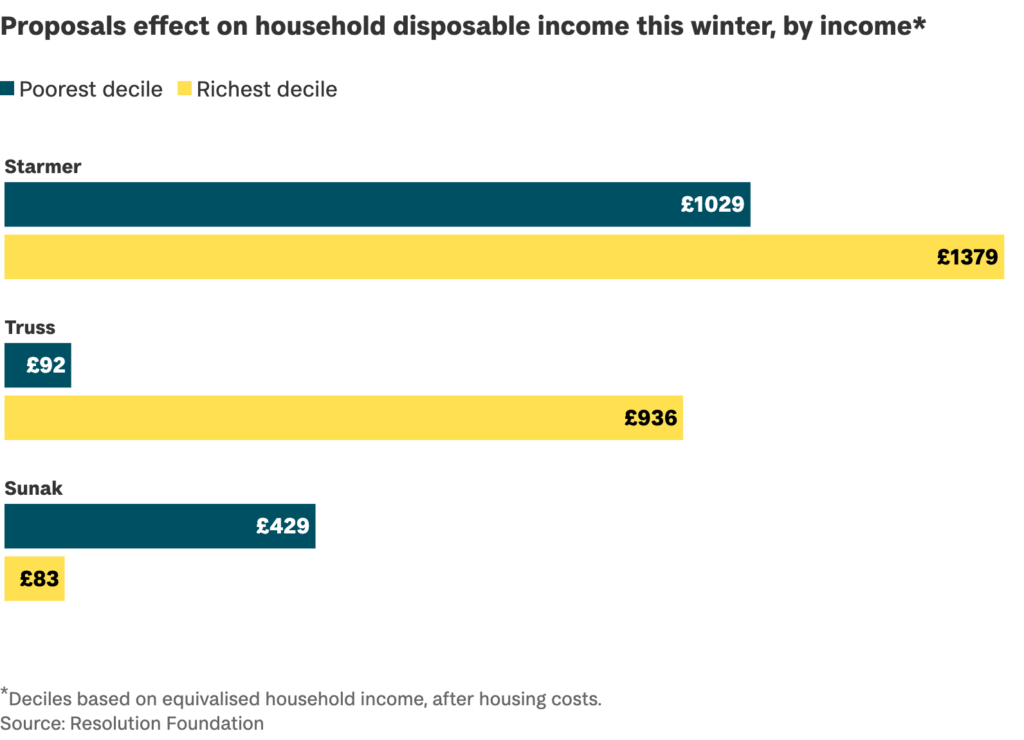
Ofgem’s announcement on Friday that the price cap would rise to £3,549 per year from October is accompanied by bleak estimates for the year ahead. The support packages currently pledged by Labour and the two prospective Tory leaders are succinctly described in this graphic based on a report from the Resolution Foundation as “poorly targeted, meagre, or both.”
What next?
The crisis should spur more long-term thinking about Britain’s energy policy and lead to action on:
- Resilience. The government is in talks with Centrica over reopening Britain’s largest gas storage site at Rough, which closed in 2017. Centrica claims it would have saved consumers about £100 each last winter had it been operational. Storage provides a buffer against volatile prices by allowing gas to be purchased in advance at lower prices. In the EU, stored gas provides 25-30% of normal winter consumption.
- Efficiency. Home insulation installations fell by more than 50 per cent in the first half of this year, compared with the first six months of 2021. Better insulation is vital to curb demand and emissions. The next stage of the UK’s main insulation scheme – the ECO – has been plagued by delays and faces a substantial cut in funding if Liz Truss, the favourite for PM, goes ahead with her plan to scrap green levies.
- Reliance on gas. The UK imports about half of its gas (from suppliers such as Norway, rather than Russia, which supplies very little) and relies on this fuel to heat most homes in England and Wales. The UK has pledged to phase out the installation of gas boilers. But its £450m boiler upgrade scheme will only cover 30,000 installations a year, over the three-year life of the scheme.
As for the energy market, more needs to be done to make sure regulatory failures of the past don’t add to the already high burden households are facing. Ofgem should be routinely monitoring suppliers’ risks.
It should also review whether a price cap, due to be extended beyond 2023, is the best way to protect consumers while achieving Britain’s climate ambitions. Holding prices down sustains energy demand at a time when we need to curb it.
Instead, targeting support at the poorest households and other vulnerable groups, will help shelter people from the storm. It also sets a precedent for a fairer transition to net zero, in which greater government support helps people on the lowest incomes to decarbonise their homes.
Monster monsoon
Flooding in Pakistan has killed more than 1,000 people and experts are warning that heavy rains haven’t yet hit their peak. Sherry Rehman, Pakistan’s top climate official, has described what’s happening in the country as “the ground zero” of the climate crisis, with flash floods, multiple glacial lake outbursts, heatwaves and “the monsoon of the decade” all happening at once. Flooding on the northern Indus River has been exacerbated by glacier melt while the southern province of Sindh has had nearly 800 per cent of its normal rainfall levels this year. 33 million of Pakistan’s 230 million people have been affected. The devastation comes as Pakistan is already in the grips of an economic crisis. The IMF is expected to approve a release this week of $1.2 billion as part of the country’s bailout program but foreign minister Bilawal Bhutto Zardari has appealed to the international community and agencies to provide more aid.
All at sea
Attempts to pass a global treaty on protecting oceans have once again stalled. The UN Ocean Treaty would set rules for protecting biodiversity in two-thirds of the world’s oceans outside territorial waters, but a fifth round of negotiations ended on Saturday with campaigners criticising wealthy nations for failing to compromise on key issues such as fishing rights and support for developing countries. The last international agreement on ocean protection was signed 40 years ago and covers just 1.2 per cent of the world’s seas. Placing limits on fishing, shipping and deep sea mining in protected areas is essential to combat the extinction crisis now facing many marine species, especially sharks and rays. Oceans are responsible for absorbing 30 per cent of greenhouse gas emissions, and are bearing the heaviest impact of climate change. We should take better care of them.
Hydrogen pact
In an effort to curb Europe’s reliance on Russian fossil fuels, Canada and Germany have signed a pact to begin shipping green hydrogen produced by wind farms across the Atlantic. The first shipments are due to arrive by 2025. For Germany, it offers an opportunity to decarbonise the country’s hard to abate sectors by burning the gas at temperatures hot enough to make steel. For Canada, it’s the latest attempt to position itself on the world stage as a “green” exporter of clean power sources and transition metals like cobalt and lithium. Olaf Scholz, Germany’s Chancellor, has also been urging Canada to increase its exports of LNG to Europe. But Canadian officials have so far rejected the idea, saying that there must first be a “business case” to justify building export infrastructure on Canada’s east coast.
California’s cars
California’s audacious plan to ban sales of new internal combustion engines by 2035 is set to have far-reaching consequences. Roughly a dozen other states, including Massachusetts, New York, Oregon, Vermont and Washington typically adopt California’s stricter standards on car pollution and have suggested that they will move to the same this year, once the EPA grants California a waiver to enforce the new rules. Legal challenges are also likely to follow. If challenges to the waiver are successful it will give ammunition to attorneys general from Republican states who are litigating against California’s ability to set its own pollution rules. There’s also concern that the rule doesn’t affect used cars and trucks sold in California. The Golden State’s old bangers have the potential to go on polluting until 2050.
Thanks for reading.
Barney Macintyre
@barneymac
Jeevan Vasagar
@jeevanvasagar
With thanks to our coalition members: a network of organisations similarly committed to achieving Net Zero