
What just happened
- Sarah Palin lost a special congressional election in Alaska to Mary Peltola, a Democrat in favour of abortion rights.
- The chairman of the board of Lukoil died after falling out of a hospital window, and after criticising Russia’s war in Ukraine.
- The UN’s human rights chief said China’s treatment of Uyghur Muslims may be crime against humanity, 11 minutes before she officially left the job.
Voters overwhelmingly reject the way the Conservatives are choosing their next leader and the UK’s next prime minister, according to a new poll.
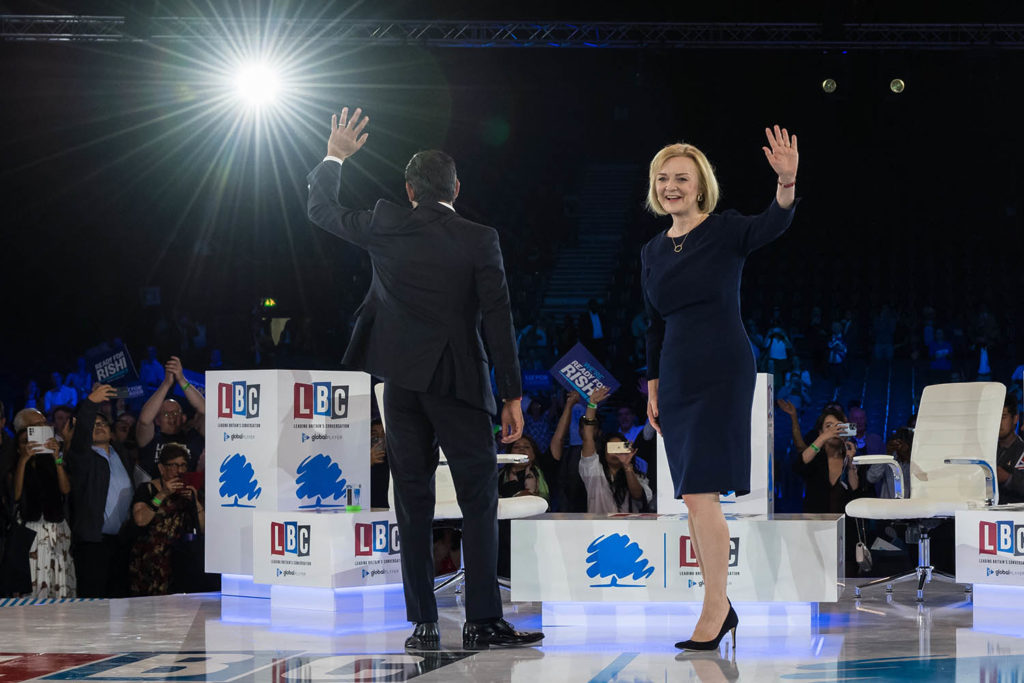
Fewer than one in seven people approve of the party’s reliance on local members in the final choice between Rishi Sunak and Liz Truss, a YouGov poll for Tortoise found. Even among Conservatives, only one in five support the system being used.
Instead, three-quarters of adults eligible to vote believe there should either be a fresh general election or the decision should be left to MPs. The poll findings are published as the former Conservative Party chief executive responsible for the current system calls for a rethink.
The process is “agonisingly protracted” and the voting membership doesn’t reflect the views of Conservatives as a whole, Archie Norman writes today for Tortoise.
Large majorities of voters of all political affiliations believe the election of the party leader serves a public function, and that therefore
- information about those eligible to vote should be publicly available;
- all those entitled to vote should be on the electoral register;
- there should be an independent system to check the list of those entitled to vote; and
- there should be an independent system to check the security of the voting system and the validity of the result.
None of these principles is being upheld by the Conservative Party, which is why Tortoise is preparing to seek judicial review of the leadership election. The purpose is to force greater disclosure about the party membership and establish whether the election is in fact legal under common law and the European Convention on Human Rights.
David Allen Green, the lawyer and blogger, wrote this week in support of the idea that the Conservative Party’s function in holding this election – not its status as a private institution – is the key legal point in deciding whether judicial review is appropriate.
“Often what constitutes a public body – such as ministers of the crown or statutory corporations – is obvious,” he wrote. “But the test is functional – if you are an entity exercising a public function then you are amenable to judicial review.”
Peter Kellner writes:
Liz Truss will break new constitutional ground if, as seems certain, she becomes prime minister next week. She will be the first occupant of Downing Street to arrive there without the endorsement of either the general public or her party’s MPs.
In the past fifty years, four became PM at general elections (Harold Wilson, Margaret Thatcher, Tony Blair, David Cameron), while another four reached the top of the greasy poll as the choice of their MPs (James Callaghan, John Major, Gordon Brown, Theresa May). Boris Johnson was elected by grassroots Conservatives, but also with the support of most Tory MPs. Truss will take over having won the votes of less than a third of her party’s MPs.
Tortoise has commissioned YouGov to examine public attitudes to this novel situation. First, given that we have now increased from two to three the ways in which a prime minister may be chosen, do voters approve of this new process? The response is emphatically no:
The responses from the public as a whole are decisive but not, perhaps, surprising. With almost two-thirds of voters now backing Labour, the Liberal Democrats, Greens or SNP, the wish for a general election to end 12 years of Conservative rule is plainly strong.
The more striking finding is that few Conservative voters favour the system that is making Truss prime minister. They are evenly divided between a vote by grassroots members (21 per cent) and the choice being made by MPs (22 per cent), but even adding the two together takes us to only 43 per cent, less than the 49 per cent who, even though they voted Tory last time, think this is an issue for the general public, not just the party.
Tortoise’s campaign to test the constitutionality of the current leadership election is focusing not just on the overall principle but whether it complies with the European Convention on Human Rights, which the United Kingdom not only accepts, but which was largely written seven decades ago by the Conservative minister and prominent lawyer, David Maxwell-Fyfe (later Lord Kilmuir).
The issue turns on whether the leadership ballot is of a type that requires certain rules to be followed. YouGov posed the question as follows:
Once again, the public verdict is emphatic. Clear majorities of both the electorate as a whole and Conservative voters regard leadership elections as having a public function. Fewer than one Tory voter in five backs the position of the party leadership. As Tortoise reported earlier this week, Darren Mott, the party’s chief executive, insisted that the election was “a private matter for the members of the Party” and that the party “does not carry out public functions”. Few Tory voters, let alone the wider electorate, agree.
It is, of course, possible that voters agree that party elections have a “public function” in general without necessarily being concerned about the specific rules that the ECHR says should be followed. However, YouGov found big majorities in favour of the application of the four main rules:
As these figures show, there is little difference between the views of Conservative voters and the wider public. In each case, the margins in favour of applying the rule vary between three-to-one and eight-to-one.
Does all this matter? We are governed by parliament and the rule of law, not by opinion polls and popular emotion. As a pollster, I’m as appalled as anyone by the notion that politicians should allow the public mood to override their considered judgment.
However, the health of a parliamentary system depends on a broad acceptance that however much we dislike particular policies, we respect the democratic mandate that underpins them. This autumn, Truss will unveil her plans for tackling the energy and inflation crisis. Millions of us, maybe a majority, will dislike them. But it’s not just the fairness of those plans that will concern many of us. Most of us reject the process by which Truss will reach Downing Street – both the principle of the choice being made by local party members and the way that the election is being conducted. We endorse the rules that have been set by the ECHR and which the Conservative Party is plainly breaching.
If Truss’s government is buffeted by the pressures of the coming winter months, it may not just be the measures that anger voters, but doubts about the legitimacy of her being in a position to decide them in the first place.
Peter Kellner is a founder of YouGov, who questioned 1,716 electors across Britain between August 30 and 31.


