What just happened
- Kwasi Kwarteng scrapped plans to lower the UK’s top rate of tax, ten days after announcing them (more below).
- Luiz Inácio Lula da Silva failed to win enough votes to defeat Jair Bolsonaro in the first round of Brazil’s election.
- A major Iranian university suspended classes after clashes between students and security forces as protests continued nationwide.
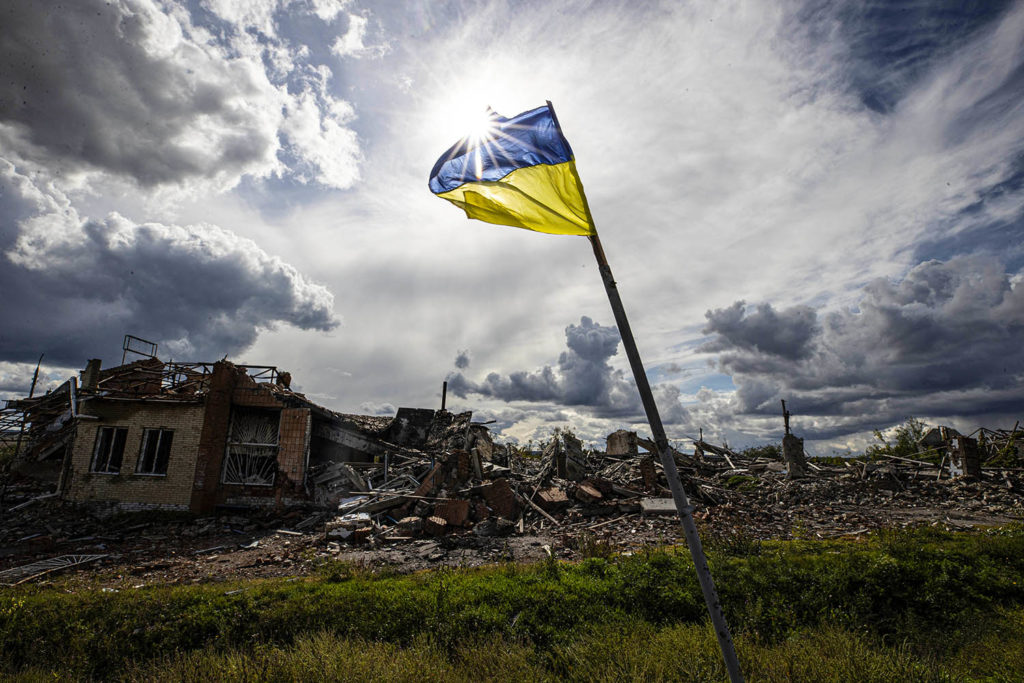
The Ukrainian flag was flying in Lyman within 24 hours of Putin’s annexation of Donetsk. This morning there are reports of the Russian front collapsing in parts of the south. Anyone who wants a rules-based international order will hope for similar news from Donetsk itself, Severodonetsk, Luhansk, Lysychansk, Mariupol and Kherson; for the end of Putinism and a long-delayed Russian reckoning with history.
But that is an extravagant hope. This war has upended what the first President Bush called the New World Order. World bodies that kept a place for Russia have been made to look ridiculous. Minor tyrants have been made to look respectable compared with Putin, and this disorder may take longer to fix than it takes Ukraine to win on the battlefield.
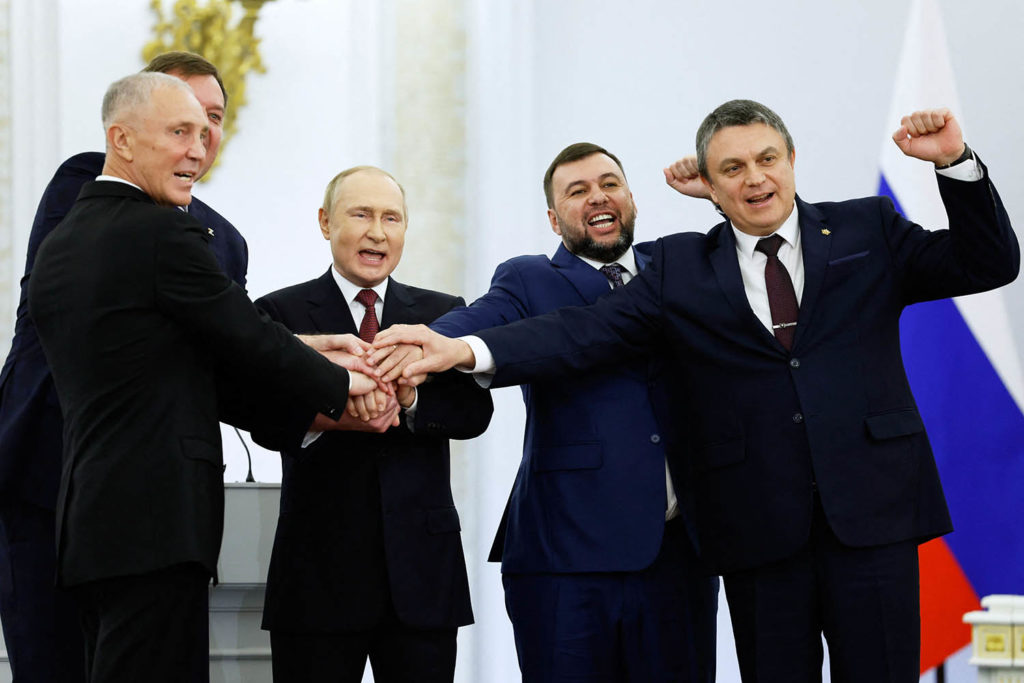
Putin’s supposed annexation of four regions of Ukraine on Friday has been condemned by the EU, US, UN and UK, but
- Russia is still a member of the UN Security Council;
- the International Atomic Energy Agency has not been able to guarantee nuclear safety at the Zaporizhzhia Nuclear Power Plant, occupied by Russian army;
- an OSCE monitoring mission deployed to eastern Ukraine in 2014 left the country the day after the invasion and has not been able to return; and
- the UN and the International Human Rights Commission have been unable to get access to the Olenivka prison camp where 52 Ukrainian POWs were killed in July.
“Key international institutions failed to prevent Russia’s war of aggression and conquest,” Ivo Daalder from Chicago Council says, adding Nato, which said it would not intervene directly, to the list. Ukraine’s Volodymyr Zelensky has since asked for fast-track Nato membership, and been politely declined.
Europe. The EU has not splintered but its solidarity in the face of Russia’s weaponisation of energy exports has been exposed as fragile.
- Germany has delayed committing to sanctions on Russia and military aid to Ukraine;
- Hungary has flatly rejected sanctions without so far being sanctioned itself in relation to the war;
- the EU has failed to impose a ban on tourist visas for Russians.
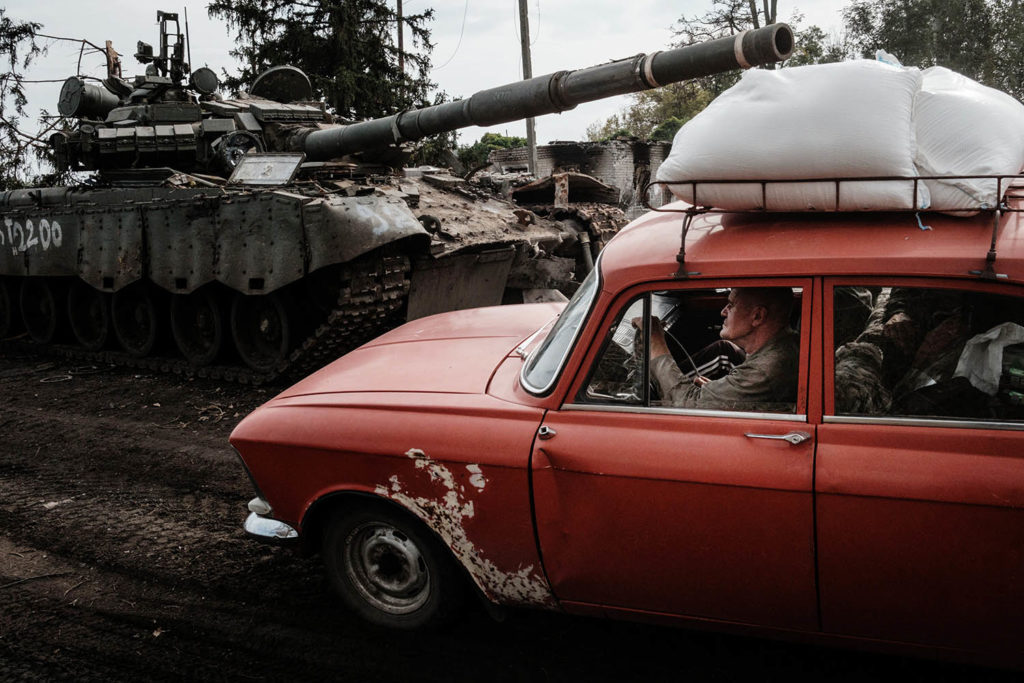
Eastern opportunities. The war in Ukraine has created openings for anti-democratic players. The role played by Saudi Arabia’s Crown Prince Mohammed bin Salman in the release last month of 10 foreign POWs brought him back to international politics four years after the murder of Jamal Khashoggi. Partial boycotts of Russian oil have brought a bonanza for state-operated Saudi Aramco, the world’s biggest oil exporter and most profitable company with profits of $280 billion in the year to September. Turkey’s President Erdogan, defined by his creeping autocracy before the war, is now a mediator between Kyiv and Moscow.
Shanghai surprise. Putin may have expected loyalty from the Soviet Union’s old underbelly, but Central Asia is turning away from Russia. Last month’s meeting of the Shanghai Cooperation Organisation was a disaster for the Kremlin: snubbed by Kazakhstan’s president on a stopover in Astana and by Uzbekistan’s prime minister at the airport in Samarkand, Putin was then lectured in private by China’s Xi Jinping and in public by India’s Narendra Modi on the unwisdom of his war.
Nuclear normalisation. Putin has dragged the threat of nuclear war from the closet marked “theory” into the everyday. Yesterday Lloyd Austin, the US defence secretary, said Putin’s threats to escalate may not be bluff. For the first time since the Cold War securocrats on both sides of the Atlantic are talking not only about whether he might go nuclear, but how. Options include
- a “demonstration shot” in the Black Sea;
- detonation of a “low-yield” weapon on a Ukrainian military target, killing thousands;
- use of a higher-yield weapon, three to six times bigger than the Hiroshima bomb, to destroy Kyiv and decapitate the regime; and
- nuclear strikes on Nato targets in Central Europe.
The second two are highly unlikely. The first two are plausible. The US Air Force’s escalation vortex model of potential nuclear conflict has 4 stages: space, cyber, conventional, nuclear. Russia has explored three so far. Space cooperation with the US and Europe has been suspended. It is accused of “increased malicious cyber activity” and it has been conducting a conventional war in Ukraine for seven months. Former US General David Petraeus says Biden’s list of options in the event of nuclear escalation will include using US forces to sink the entire Russian Black Sea fleet.
Daalder says the G7, EU, IMF and Nato should “drive a response increasing the cost on Russia of violating the rule of law to such an extent that its aggression is reversed”. But that is a more complex task than shipping armaments to the front, and given Putin’s rhetoric it has to be assumed that time is short.