What just happened

- Tigrayan and Ethiopian leaders signed a truce to end a two-year civil war that may have killed more than half a million people.
- North Korea test-fired three missiles including a long-range ICBM that may have malfunctioned.
- Five lions escaped from their enclosure in a Sydney zoo and had to be tranquilised to be recaptured.
The 2019 election gave Britain a Conservative majority, a Red Wall of Tory seats that had been Labour – and Workington Man.
This new archetype came from a blue-collar town in Cumbria. According to the Tory think tank that conceived him, he was:
- over 45, white, living in a town in the North or the midlands;
- without a degree; rooted in his local life from pub to post office;
- a Leaver; feeling politically voiceless in a globalised world; and
- politically motivated mainly by crime and immigration.

Now he’s history. Yesterday, the UK’s foremost polling expert appeared to kill Workington Man off. In a briefing with journalists Professor John Curtice of Strathclyde University said the challenges facing the Tories were so severe there was no point focusing on a target demographic.
“Targeting only matters when it’s close,” he said. “We are nothing like close.” People no longer trust the Conservatives to run the country so they’re losing voters in all areas and all sections of society.
But if Workington Man is on life-support, immigration lives on as a third rail of politics, economics and public debate:
Immigration and politics. Immigration is being invoked by both main parties in a bid for the four million voters estimated to have deserted the Tories.
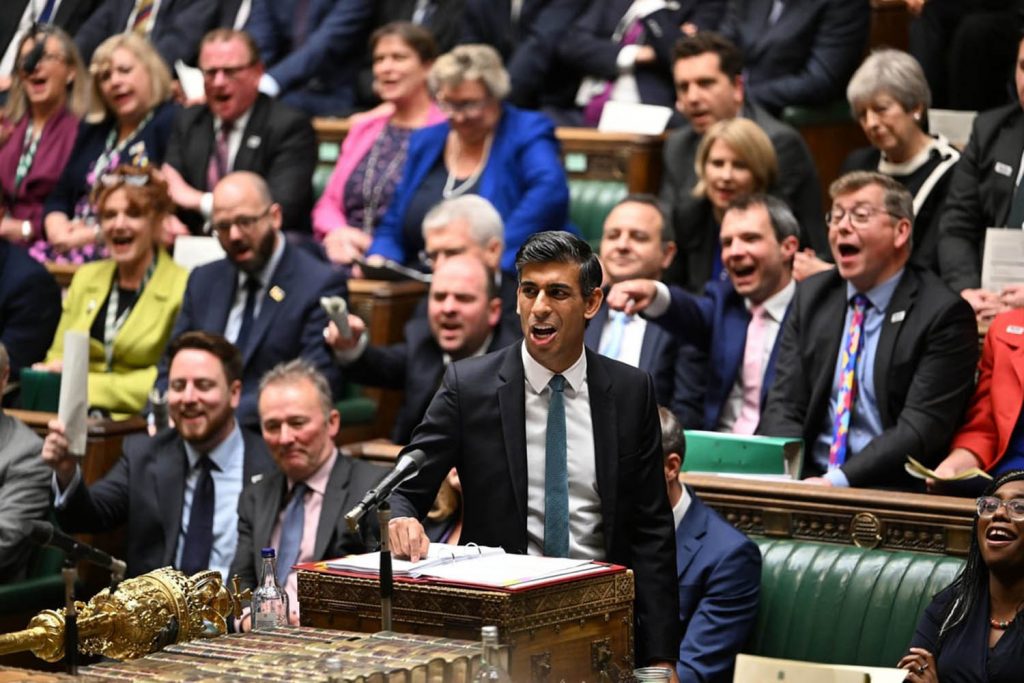
During his second Prime Minister’s Questions, Rishi Sunak said it was an “escalating problem” – less incendiary than the home secretary’s “invasion” the day before, but still a signal that he recognises a political emergency in daily headlines about cross-Channel migrants.
Sunak was challenged repeatedly on the emergency by Labour’s Keir Starmer. Having already parked his tanks on the Tory lawn marked economic (mis)management, Starmer evidently now fancies his chances on immigration too.
There are two problems, for both parties, with this strategy:
Problem #1: Immigration is hard – perhaps impossible – to control.
Problem #2: There is a growing realisation that immigrants are economically valuable and culturally beneficial.
Immigration and economics. The Office for Budget Responsibility estimates that net post-Brexit immigration in the UK will settle at around 129,000 annually. Oxford’s Migration Observatory says it’s likely to be above 200,000. In fiscal terms, more is better.
The FT estimated last week that the difference between those two numbers could fill £5-£8 billion a £40 billion hole in the UK’s public finances.
It won’t be easy for Sunak to pivot to a more immigration-friendly position. Suella Braverman, his home secretary, has said she wants net inward migration in the “tens of thousands” as well as planeloads of asylum seekers being flown to Rwanda. A tough stance on immigration is implicit in Sunak’s decision to restore her to the Home Office.
But the only issue that voters really care about – the cost of living crisis – may require a change of tack.

Immigration and the public. Anti-immigrant sentiment has receded since the 2016 referendum. Inflation has rendered immigration a second-order concern for now, and
voters at large tend not to obsess about asylum-seekers in small boats as do the Daily Mail and the Conservative grassroots. But party activists still have outsize influence in Downing Street. As a Number 10 source told Tortoise’s Matthew D’Ancona last week, “Rwanda tests through the roof in private focus groups”.
Onward, the think tank that invented Workington Man, found in a recent survey that 35 per cent of the public put their likelihood of voting Conservative at zero. A source there says to have any chance of winning at the next election, both Labour and the Tories have to target town-dwelling socially conservative, economically interventionist voters.
FWIW: Onward director and Workington Man co-creator Will Tanner is being lined up to enter Number 10 as Rishi Sunak’s new deputy chief-of-staff. Workington Man may be receding into the political rear-view. Anti-wokeington man, not so much.
Rates way up
Spare a thought for central bankers. Their job is to keep inflation under control but their main tool, interest rate rises, fuels inflation by driving up mortgage costs. It must be almost as frustrating as… higher mortgage costs. The Bank of England is expected to raise base rates by three quarters of a point today, following the Fed and the European Central Bank, which did the same thing yesterday and last week respectively. These are big jumps – the biggest, in the UK’s case, since 1989. The ECB’s Christine Lagarde reckons neither the rate rise nor a mild recession will be enough to tame inflation in the Eurozone, so stand by for more upward pressure on rates there. But in the Anglosphere economists now say rates will peak at around 5 per cent, at least a point lower than feared barely a month ago. That will be good for everyone except possibly pension fund managers, whose liabilities tend to grow as rates – and yields on long-dated bonds – fall.

Fenced out
Poland has started building a razor-wire fence along its 210 km border with the Russian exclave of Kaliningrad. The boundary is currently only monitored by guards, but there are fears the Kremlin may deliberately send migrants from Africa and Asia across it to destabilise Poland. Although there were no illegal crossings last month, the tactic has precedent – last year Russia’s ally Belarus was accused of sending migrants into neighbouring Poland to cause disruption. Poland’s solution then? Also a fence, completed in June. The new one is due to be finished by the end of next year.

Mushroom magic
A synthetic version of the psychedelic compound found in magic mushrooms could help treat depression in people who’ve had no luck with other therapies. A study in the New England Journal of Medicine found that a single 25 milligram dose of the drug, known as COMP360, kept depression at bay better than conventional antidepressants and better than lower doses. The study was based on a trial involving 233 people suffering from treatment-resistant depression, some of whom were given 1 milligram doses, some 10 milligram doses, and some the biggest dose. Biggest was best. Improvements were seen within a day and lasted for weeks. More than 100 million people worldwide live with treatment-resistant depression.
Bribes cost
Employees at Glencore, the Swiss mining giant, paid millions of dollars in bribes to officials in five African countries, Britain’s Serious Fraud Office (SFO) told Southwark Crown Court this week. The UK subsidiary of Glencore allegedly used private jets to fly cash bribes to South Sudan, where they were provided to a local agent who passed the money on. A week later, Glencore was rewarded with millions of barrels of crude oil. Alexandra Healy KC, for the prosecution, said “offering of bribes was an acceptable way of doing business for the company” and that “corruption was endemic within the corporation”. Glencore is expected to pay up to £93.5m in proceeds of crime (because this was the amount it made from the bribes) and at least £81m in penalties. Glencore pleaded guilty to separate bribery offences in June, for which it expects to pay up to $1.5 billion in fines. It made profits of $5 billion last year.

Israel’s right
Israel’s Benjamin Netanyahu left office 16 months ago with a promise to return. Power is now within his grasp again: with 90 per cent of votes counted from Tuesday’s election, Israel’s fifth in less than four years, Netanyahu’s right-wing coalition is on track to win between 62-65 of 120 seats in parliament. A win would help shield Netanyahu from an ongoing corruption trial. But the big winner of the election is Itamar Ben-Gvir, whose far-right Jewish Strength party is part of the Religious Zionist grouping that doubled its seats in this election. Ben-Gvir has been convicted as a racist and pointed a gun at Palestinians during clashes last month. His followers openly espouse a vision of Israel without Arabs. As co-leader of the third biggest party, he may now expect a cabinet position overseeing the police.
Thanks for reading. Please share this round, send us ideas and tell us what you think. Email sensemaker@tortoisemedia.com.
Catherine Neilan
@CatNeilan
Additional reporting by Sebastian Hervas-Jones, James Wilson, Giles Whittell and Jess Winch.
Photographs Getty Images, Jessica Taylor/UK Parliament