
What just happened
- Opposition parties said Bola Tinubu’s “win” in Nigeria’s presidential election was rigged.
- Two trains collided head-on in northern Greece, leaving at least 32 people dead.
- Dozens of schoolgirls were taken to hospital in Iran with suspected poisoning.
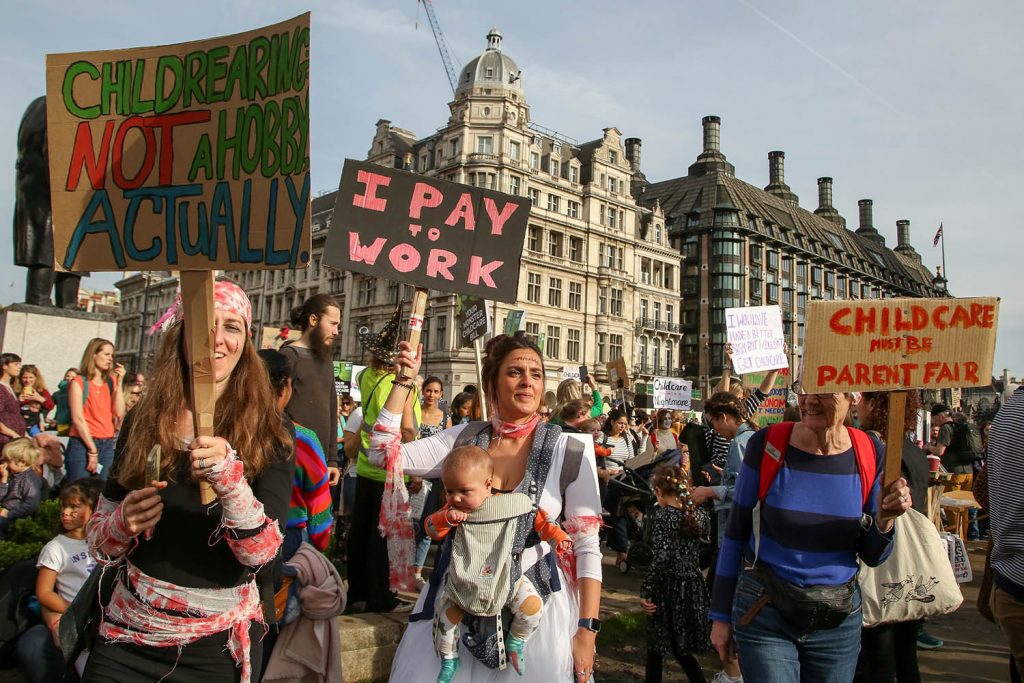
Childcare providers across the UK are sending out letters to parents warning of rising prices, with calls for the government to address the exorbitant costs of early years childcare growing louder ahead of next month’s budget.
So what? They have a point. The childcare system in the UK is broken. Parents (often women) are stopping work or reducing their hours because they cannot afford childcare costs; early years professionals are quitting; nurseries are closing.
By the numbers:
£14,000 – average cost of a full-time nursery space in Britain, with average London fees closer to £20,000.
£32,000 – average UK household income after taxes.
1 – the UK is the most expensive country in the 38-member OECD for care for 2 and 3 year-olds, relative to wages.
89 – per cent of childcare providers in England planning to increase fees this year.
Government spending on early years childcare has risen from around £1.5 billion in 2001 to more than £5.3 billion in 2021, largely due to state-funded childcare hours. Since 2017, one scheme allows some working parents in England to claim up to 30 hours of free childcare a week for 3 and 4 year-olds during term time.
But the state funding only covers about two-thirds of the actual cost of providing those childcare hours, so nurseries have to make up the costs elsewhere, such as by raising fees for younger children.
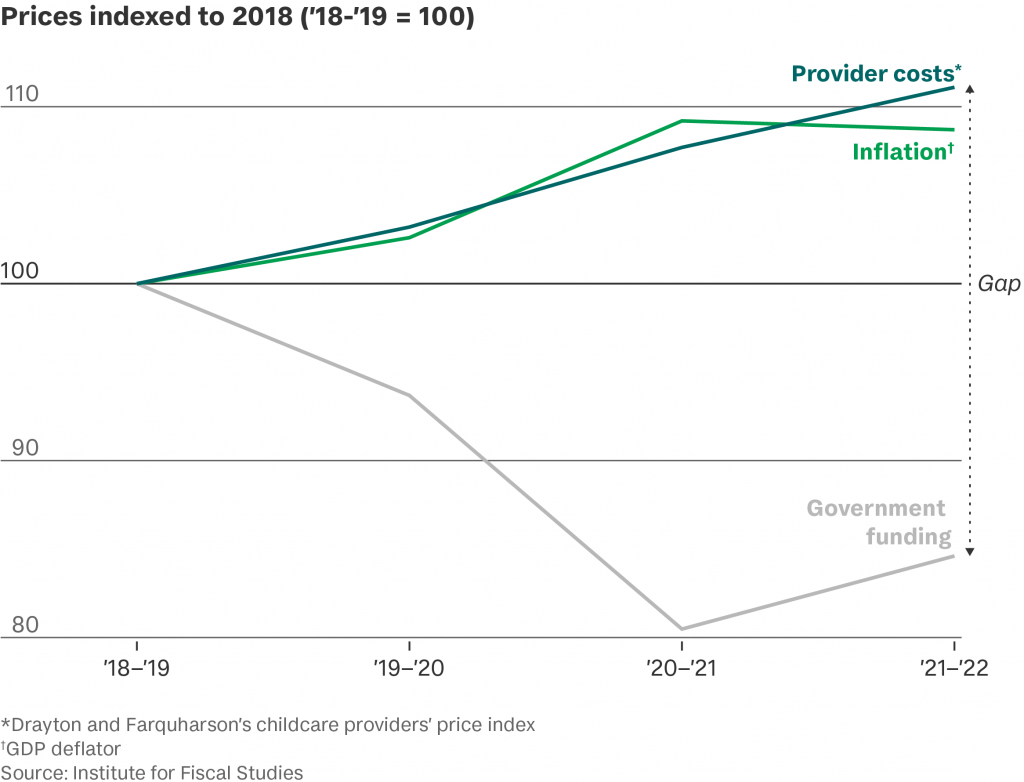
Covid-19 and the cost of living crisis turned a difficult situation into a disaster:
- Nurseries faced with financial pressures and difficulty recruiting staff are closing, with 4,000 childcare providers in England shutting in the year to March 2022;
- Early-years professionals are quitting the industry because they are underpaid (a 2020 report found that the workforce – which is 97 per cent female – earned an average hourly wage of £7.42) and feel undervalued;
- Parents are delaying having children due to childcare costs, while some are cutting down on essentials such as groceries to cover fees.
Studies suggest around 1.7 million women are prevented from working more hours because of childcare issues, resulting in up to £28 billion in lost economic output each year.
“Even five years ago, when we used to have conversations with ministers about childcare, they’d look at you like you were speaking Klingon,” says Joeli Brearley, founder of Pregnant Then Screwed. “In that time, the cost of childcare has risen so dramatically that this is now an issue that is genuinely impacting middle-income families… and so you’ve now got more parents making noise about this issue.”
How to do better. Canada is implementing universal low-cost childcare building on the example of Quebec: the government is pledging huge investment to bring childcare fees down to $10 per day on average within five years. In Australia, the Labour government returned to power partly on a promise of cheaper childcare, committing an additional A$5.4 billion to increase subsidies for parents and carers.
Bridget Phillipson, the UK’s shadow education secretary (who visited Australia last month) has promised that a Labour government will “transform” the system, offering more support from the end of parental leave until the end of primary school. So far, the party has promised free breakfast clubs for every primary school-age child in England.
Conservatives have proposed loosening the ratios between staff and children at childcare providers – something campaigners say would reduce safety without having an impact on cost. Instead, early-years providers and organisations including the Confederation of British Industry are calling for Chancellor Jeremy Hunt’s budget to include measures like
- increased funding to reflect the actual cost of subsided hours;
- extended free hours to one and two year-olds; and
- changes the Universal Credit system so parents do not have to pay costs upfront.
Baby steps, if you like.
ICE wants a comeback
The single most important constituency behind the world’s switch from internal combustion engines to battery-powered cars is having second thoughts. Germany’s auto industry wants ICE technology to be granted a life extension beyond 2035 provided the engines use carbon-neutral synthetic fuels. The industry has allies among the Free Democrats in Olaf Scholz’s ruling coalition, including transport minister Volker Wissing, who now says ICE tech with e-fuels “must be allowed on a permanent basis”. It’s true much of Germany’s economy depends on suppliers to the car industry, many of which have no role in a battery-powered future. But if Germany wobbles on the 2035 deadline Europe will have to push it back or forget about it, and the US and China will either follow suit or take more of Europe’s share of the electric vehicle market. Neither is good. E-fuels, by the way, are a misnomer. They all produce CO2 when burned and are only carbon neutral if all the H2 used to make them is green.
Where dreams come true
Florida’s Governor Ron DeSantis has ended almost 56 years of Disney control over the self-governing area encompassing Disney’s Orlando theme parks. “There’s a new sheriff in town,” he said on Monday after signing into law a bill prompted by a feud with Disney over his “Don’t Say Gay” law, which Disney’s then-CEO criticised last year. DeSantis responded by calling for Florida’s legislature to dissolve the arrangement that gave Disney control over municipal services and development in its parks. DeSantis says he opposed Disney’s special status as an example of special corporate privileges. The bill he signed this week is almost exclusively a gubernatorial power grab. All it really does is change the name of the area and give the governor the power to appoint its five board members. The five DeSantis has chosen include a conservative education activist whose husband is the chair of the Florida Republican Party and a prominent attorney whose investment firm recently donated $50,000 to a DeSantis-aligned group.
Rewriting history
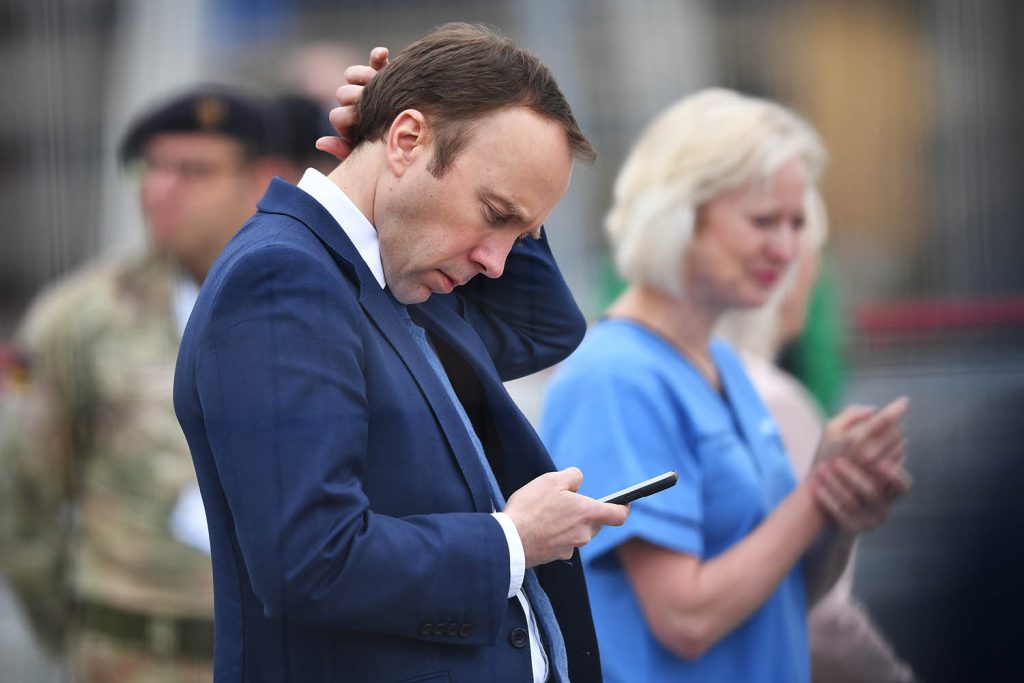
When former health secretary Matt Hancock’s memoir Pandemic Diaries landed before Christmas, it did so like a damp squib. Written with the help of journalist Isabel Oakeshott, the book sold only a few thousand copies and was criticised for “rewriting history” to restore Hancock’s reputation. In a decision Hancock likely now regrets, he gave Oakeshott thousands of WhatsApps sent to government ministers, staff and powerful friends at the height of the pandemic – messages she’s now leaked in their entirety to the Daily Telegraph. Her justification: to stop a “whitewash” at the recently started Covid Inquiry. Its first splash accuses Hancock of rejecting the Chief Medical Officer’s advice to test all residents going into care homes for Covid in April 2020. Hancock says the “stolen” messages have been “doctored” to create a false story. All the messages have already been shared with the Covid inquiry, whose public hearings start in June.
The evolution of Greta
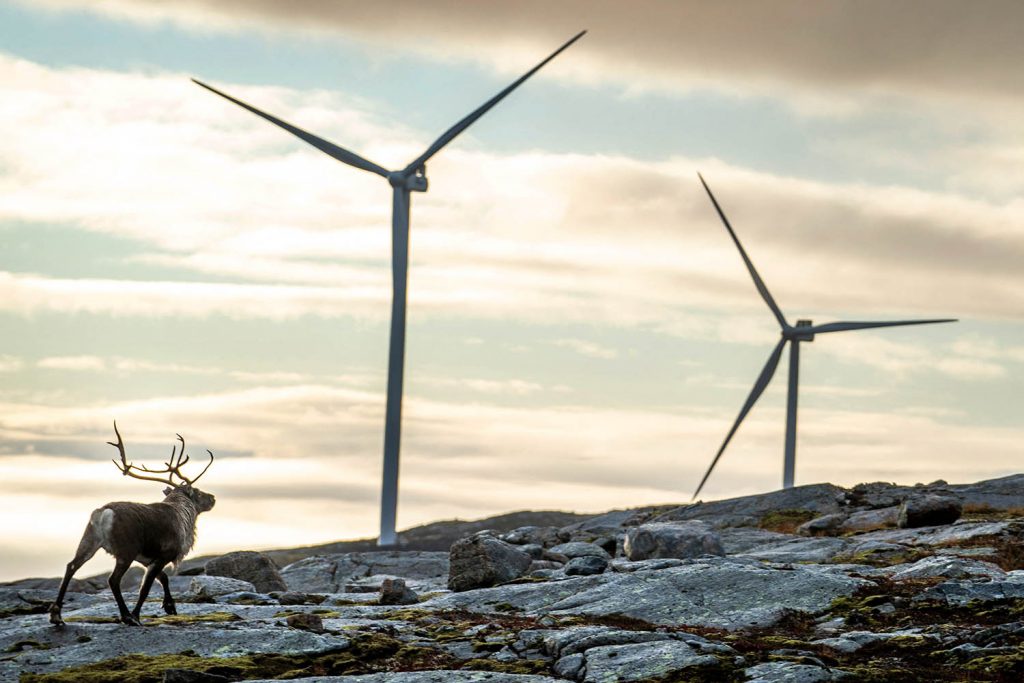
Greta Thunberg joined a protest against wind turbines yesterday. Not all wind turbines; just two wind farms deemed by Norway’s supreme court a year and a half ago to scare reindeer in the far North and thereby violate the human rights of the indigenous Sami people. Thunberg favours green power generally but said Norway’s government should have seen this coming. The energy ministry is now trying to mediate between the Sami and the wind farms’ owners, which are Swiss and German as well as Norwegian. 91 per cent of Norway’s electricity is hydropower. Wind makes most of the rest.

Russia’s reach
Ukraine is blaming Russian security forces for a wave of youth violence in Ukrainian cities, apparently based on an online animé series popular in Russia. Ukrainian police detained around 700 teenagers at 30 gatherings in the space of two days. Similar events in Russia involving young people in black clothes with spider insignia, beating up innocent bystanders whose clothes they don’t like, are said to have been inspired by the “Hunter x Hunter” animé series. Ukraine has accused Russia’s FSB of promoting a violent teenage subculture via social media to “destabilise the internal situation”. Separately, two former Russian propagandists have been suspended by Voice of America, the radio network initially created to counter Nazi Germany’s propaganda, after their presence there was reported by the Kyiv Post.
Thanks for reading. Please tell your friends to sign up, send us ideas and let us know what you think. Email sensemaker@tortoisemedia.com.
Jess Winch
@jswinch
Additional reporting by Phoebe Davis, Nina Kuryata, Maddy Diment, Sophie Barnett and Katie Riley. Graphic by Katie Riley.
Photographs Getty Images