
What just happened

- E Jean Carroll wept in court after describing being raped by Donald Trump.
- Xi Jinping phoned Volodymyr Zelensky and urged him to negotiate with Putin.
- Microsoft said Britain was closed for business after regulators blocked its purchase of Activision Blizzard.
British MPs took a big step last night towards approving a new law designed to stop refugees trying to cross the English Channel in small boats.
So what? It won’t. Refugees will go on trying as long as they can get to northern France. What the bill will do is
- violate the UK’s obligations under the UN Convention on Refugees by making it illegal to claim asylum on arrival without permission;
- lead to the detention and in principle the deportation of people arriving in small boats, including children; and
- allow the prime minister and home secretary to tell voters before the next local and general elections they are fulfilling a pledge to get tough on illegal immigration.
The politics. The Illegal Migration Bill is part of Number 10’s attempt to shore up support among MPs and voters, but it has also reinforced the divisions in the Conservative party. Rishi Sunak averted a potentially embarrassing rebellion when it passed by 289 votes to 230 last night but the numbers bely turmoil on the Tory benches. Sunak’s attempts to keep the Tory right onside may prove a pyrrhic victory.
Why? Rebels and would-be rebels are calculating that the PM will be out after the next election, and they might as well be prepared should a crisis derail him before then. Sources say several cabinet ministers are already on manoeuvres.
Expectations for next month’s local elections are low, but MPs say if the Conservatives’ results are worse than in 2019, letters could start trickling in to the 1922 Committee. Although a no-confidence vote is far from likely, Sunak was seen working the tea room after Prime Minister’s Questions yesterday – a sure sign of a fretful leader.
For the bill: support comes largely from the self-styled Common Sense Group, led by Sir John Hayes, who has the ear of Home Secretary Suella Braverman, as well as Red Wall MPs such as Lee Anderson and Jonathan Gullis.
Against: moderate One Nation Tories don’t often break cover as a caucus but they have significant names and numbers when they do:
- Former prime minister Theresa May condemned the bill for its failure to protect victims of modern slavery as “a slap in the face of those of us who care”.
- Former attorney general Sir Geoffrey Cox said the bill could allow ministers to “deliberately disobey” international obligations.
- Former children’s minister Tim Loughton, who has campaigned to create safe and legal routes for child asylum seekers, backed down from leading a rebellion but made it clear his support for the bill was conditional on ministers doing “the right thing” before the bill’s final reading.
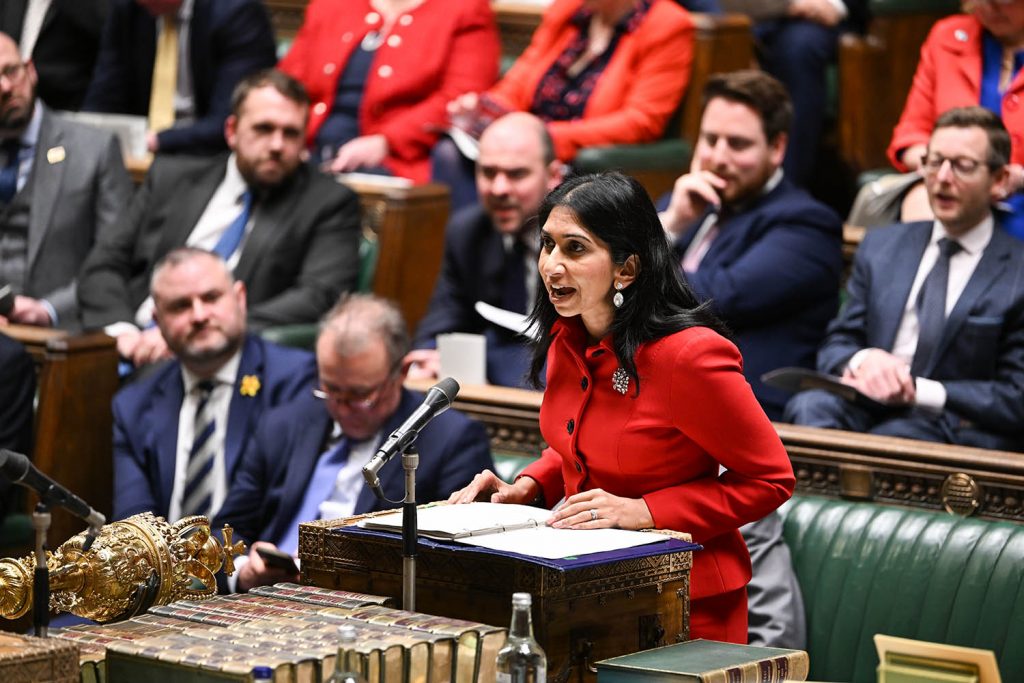
Uncivil. Suella Braverman, the home secretary, shows no sign of backing down. Yesterday she ruled out introducing a safe and legal route for asylum seekers in Sudan to seek refuge in the UK. With only anecdotal evidence from conversations with police, she said migrants arriving on small boats were “criminals” who “possess values which are at odds with our country”. Immigration minister Robert Jenrick called them “asylum shoppers”.
At sea. Tory MPs have been told by the Downing Street election strategist Isaac Levido that tackling small boat arrivals is essential to keep the party on a “narrow path” to victory at the next election. Sunak has promised to resolve the issue for the same reason. That doesn’t make his hardline approach universally popular; nor is there any confidence among migration experts that it will work. But it just might help limit the damage at the ballot box next week.

Disney sues DeSantis
The mouse ears have come off. After a year going toe-to-toe with Florida’s governor and likely presidential contender Ron DeSantis, Disney is taking him to court. What began as a dispute over a state ban on schools teaching gender identity has escalated into a political and geographical land grab in which DeSantis is trying to wrestle away Disney’s long-held ability to govern its own parks. In a 77-page lawsuit, Disney says it has been forced to defend itself from a state “weaponising its power to inflict political punishment”. It also claims a new – previously Disney-controlled – local tourist board appointed by the governor violates Disney’s contract rights, economic future and constitutional right to free speech. Even for “anti-woke” DeSantis, taking on the Magic Kingdom in court would be a bold move ahead of a presidential run. Diary note: DeSantis will be in Westminster tomorrow courting Conservatives in the final stop of a global trade tour that’s taken in South Korea, Japan and Israel.
God of chips
The world has one overwhelmingly dominant maker of the machines that print the silicon wafers in ultra-fast chips. It’s called ASML Holding NV, is based in Veldhoven in the Netherlands and is building a new machine that costs as much as a Boeing 787 and can print circuits on wafers smaller than a virus. Why? Partly because there’s a demand for them for the servers that power AI, but also because ASML needs an alternative growth strategy to the obvious one, which used to be to sell to China. Trump nixed that on security grounds and the Biden administration has doubled down on tech transfer to the country that wants to invade Taiwan. There’s a paradox at work here: sanctions as the mother of invention.


