
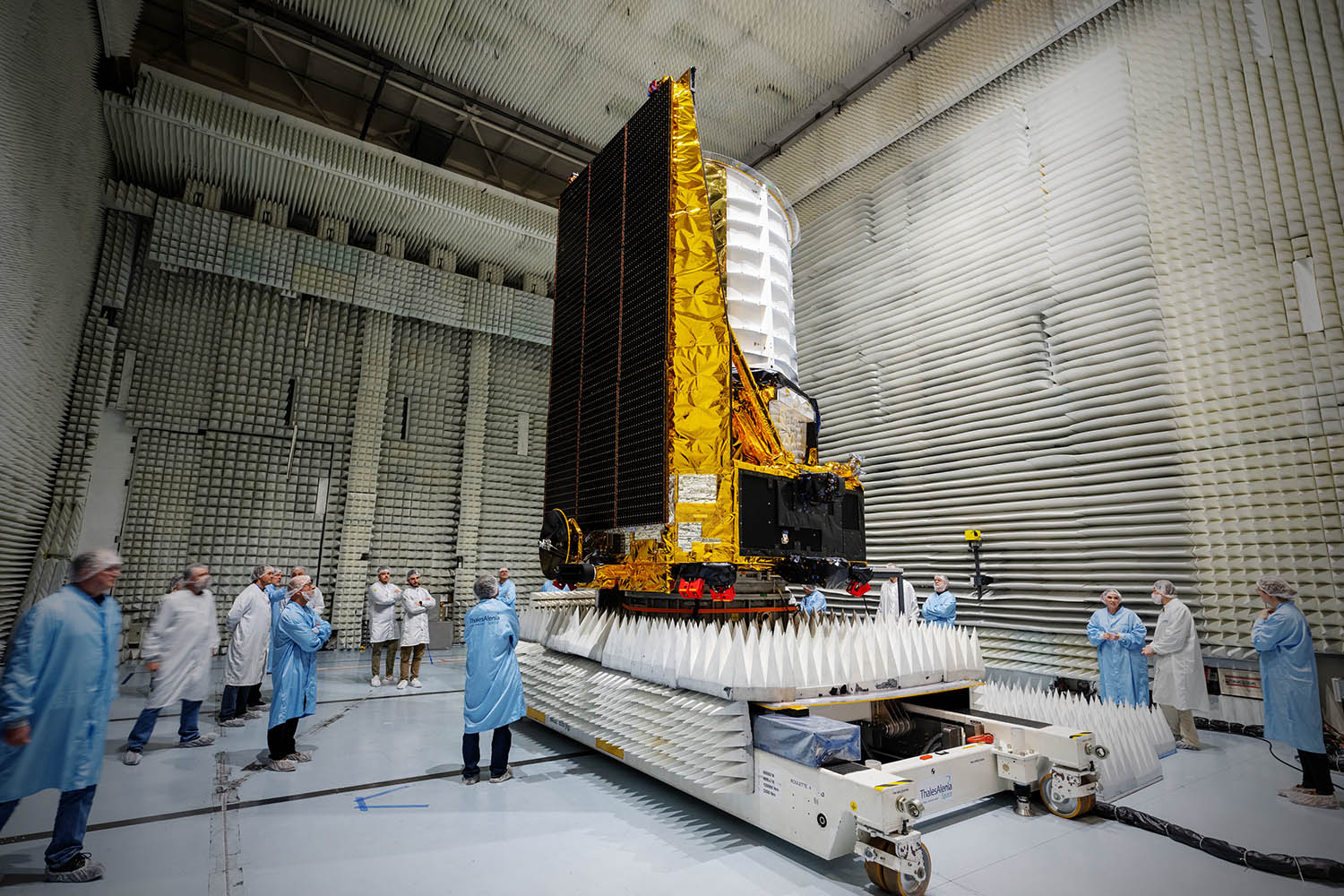
New space telescope to investigate dark matter and dark energy
The Euclid space telescope due to be launched next month could help answer a baffling and fundamental question posed by the older Hubble space telescope in 1998: how could physics have so completely misunderstood the nature of the universe? Until then, its expansion was assumed to be constantly slowing down as a result of the gravitational pull of heavenly bodies on each other. But the Hubble, peering billions of years back in time, showed its expansion was in fact accelerating. The theory concocted to explain this is that 68 per cent of everything in the universe is dark energy, 27 per cent is dark matter, while what we can see and touch constitutes less than 5 per cent. Euclid is going to sit at a Lagrange point 150 million km from Earth, pointing away from it and shielded by it from the sun. There it will take millions of pictures of deep space to be analysed for a) bending light explicable only by dark matter, and b) evidence of changing rates of cosmic expansion over time, explicable by dark energy. Euclid is an optical telescope looking for things that cannot be seen.
Photograph M. Pédoussaut/ ESA