
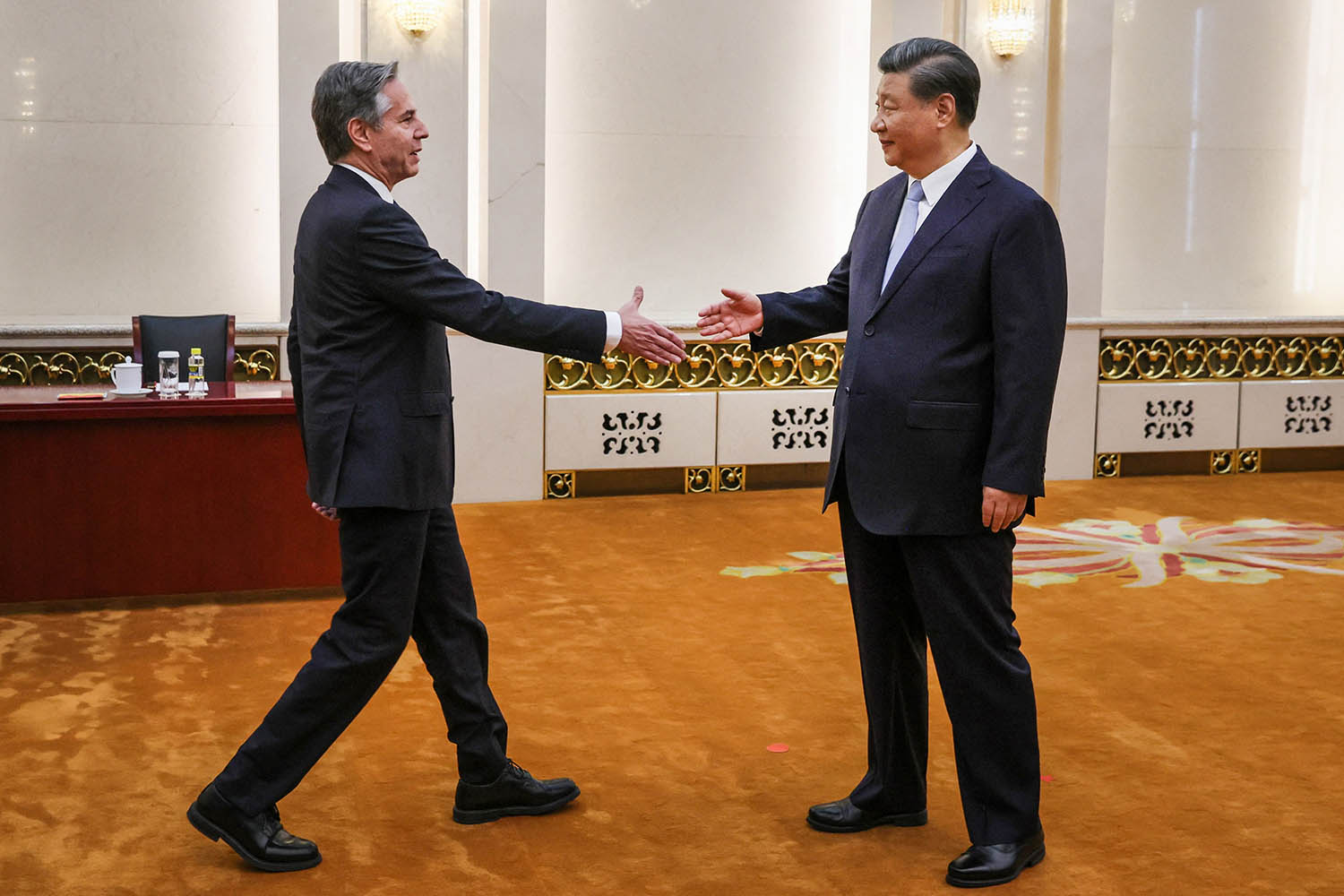
A 35-minute meeting between America’s top diplomat and the president of China might have been the moment two nuclear superpowers stopped sleepwalking towards conflict.
- British MPs backed a report that found Boris Johnson misled parliament (more below).
- The disgraced hedge fund manager Crispin Odey lost his “fit and proper” status with the Financial Conduct Authority.
- Monty Python’s ‘Always Look on the Bright Side of Life’ dropped out of the UK’s top ten funeral songs.
Tony Blinken met Xi Jinping in the Great Hall of the People yesterday. There were no breakthroughs but the US Secretary of State and the Chinese president talked for 35 minutes about the need for more talks, more flights and less fentanyl.
So what? A chat about baseball would have been progress.
- No comms. Earlier this month Jake Sullivan, Biden’s national security adviser, admitted there was no substantive security dialogue between the US and China despite the growing risk of conflict over Taiwan and, on the Chinese side, the fastest peacetime nuclear weapons buildup in history.
- No guarantees. US-China relations are so tense and uncertain that Blinken’s meeting with Xi wasn’t a sure thing on his arrival for the first cabinet-level visit to Beijing by an American official in four years, and wasn’t confirmed until an hour before it happened.
- No margins. The fact that it did happen shows Beijing can’t afford a full rupture, mainly for economic reasons, and the US can’t either, mainly for geopolitical ones.
The most complicated and important relationship in the world has three strands.
The diplomatic relationship is stressed but intact. Biden cannot afford to be seen at home as soft on China. China’s new foreign minister, Qin Gang, is a former “wolf warrior” who’s been told to rein in the histrionics but still channels what Xi calls the fighting spirit of Chinese diplomacy. He met Blinken on Sunday for “candid” but “constructive” talks, which means they talked about advanced chips (which the US wants to keep out of China) and Chinese spy balloons (which the US wants to keep out of the US), but agreed to talk again.
The economic relationship is tangled but troubled after 20 years of mutual dependence and the shock of Covid. Trade with the US helped lift 500 million Chinese out of poverty but Chinese exports are down 15 per cent year-on-year. Growth that was expected to pick up in the past two months has slowed. Urban youth unemployment is at 20 per cent. Biden has kept most of Trump’s anti-Chinese tariffs and his Inflation Reduction Act is a $1.2 trillion misnomer for a gigantic “friendshoring” campaign to boost US manufacturing and clean energy capacity at China’s expense. In the meantime 70 per cent of the world’s container traffic still passes through the Taiwan Strait.
The military relationship is moribund. There have been no formal military-to-military talks since 2022. Lloyd Austin, the US defence secretary, offered to meet his opposite number this month in Singapore but was rebuffed. There is a 24/7 military standoff between mainland China and Taiwan but no Beijing-DC hotline to de-escalate conflicts, and plenty of scope for near misses to start them. In one over the South China Sea last month a Chinese fighter nearly collided with a US reconnaissance plane. Eight days later US and Chinese destroyers came within 137 metres of hitting each other.
In the absence of a military dialogue…
- The US has taken to war-gaming worst-case scenarios. In one of these Taiwan was able to resist a Chinese invasion only if “armed to the teeth” beforehand by the US.
- Xi has told his generals to be ready to fight for the island by 2027.
In simulations run by the Center for Strategic and International Studies, such a conflict could mean a 5 per cent hit to US GDP but a 20 per cent hit to China’s and military losses so serious they posed a threat to Xi’s regime.
In the real world, Xi intends to survive and thrive, absorbing Taiwan without war if possible. To that end, as Oxford’s Professor Rana Mitter has shown, he’s been co-opting China’s World War Two history to boost Chinese nationalism’s credentials even when that means sharing the honours with Chiang Kai-Shek and the Kuomintang.
Don’t be surprised to hear talk from Chinese diplomats of the 1943 Cairo Declaration, which they say gives them a claim on parts of the East China Sea.
Do remember the context – two nuclear superpowers in a dangerous habit of talking past each other. In the business of jaw-jaw, every little helps.
About that fentanyl – Xi promised to help curb exports of fentanyl’s raw materials to Mexico.


