Sensemaker Daily
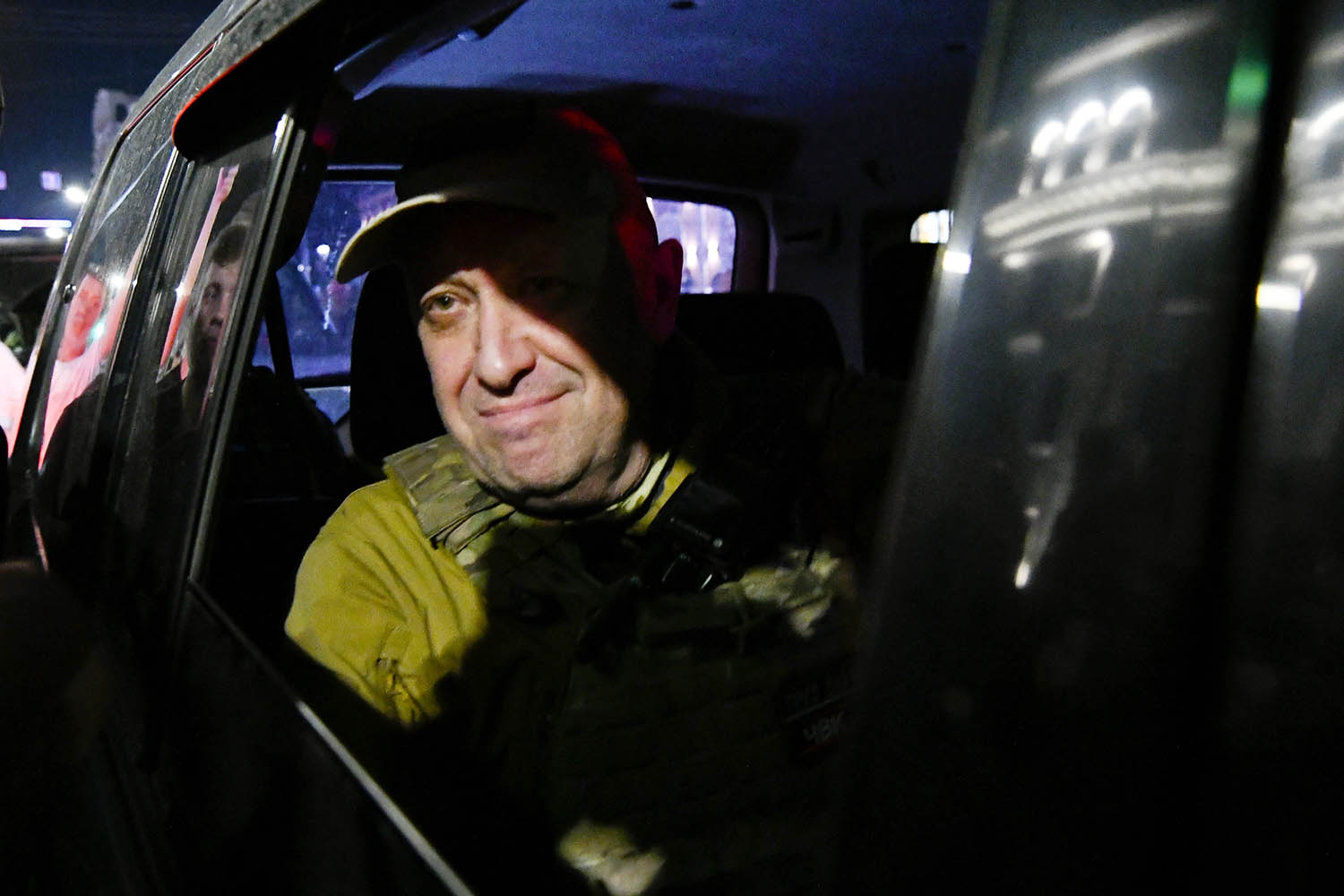
If Putin couldn’t or wouldn’t take out Prigozhin, can he escalate the war in Ukraine? The wild ride of the Wagner Group raises fundamental questions about Tsar Vladimir’s authority, including over his troops.
- Moscow’s Kommersant newspaper said Yevgeny Prigozhin was still being investigated by the FSB (more below).
- Greece’s Conservative PM Kyriakos Mitsotakis won four more years in power.
- Elton John closed Glastonbury with what may have been his last live UK show.
A day and a half after Yevgeny Prigozhin’s abortive coup, Moscow is calm. Rostov is back under Russian state control. China has backed efforts to restore stability and state TV has shown pictures of the embattled defence minister Sergei Shoigu visiting troops in Ukraine.
So what? Appearances deceive. The Wagner Group’s 300-mile advance on Moscow showed the essential weakness of the Russian state after 23 years of Putinism. Western governments now need to be ready for anything, including the unravelling of the Russian Federation.
Prigozhin blinked, but Putin did too, and the media he controls had no choice but to cover it:
- On Saturday morning Russia watched Putin call Prigozhin a traitor facing harsh retribution; by the evening the same TV channels were announcing a deal.
- Anthony Blinken, the US secretary of state, sketched out the bigger picture: “Sixteen months ago, Putin was on the doorstep of Kyiv… Now he’s had to defend Moscow against a mercenary of his own making.”
In truth a Wagner force of barely 5,000 never really threatened Moscow, which makes Putin’s humiliation all the more striking:
- The Russian army never resisted Prigozhin and the Russian people cheered him as he left Rostov.
- Having decided to avoid a military confrontation on the edge of Moscow, Putin relied on Alexander Lukashenko, the Belarussian leader he considers a lackey, to broker the deal.
- Even after his soldiers brought down Russian helicopters and a jet, reportedly killing as many as 20 military pilots, the mutineer and his men are spared.
Follow the money. Prigozhin’s stunt appears to have been prompted by a 10 June Kremlin decree ordering all “volunteer” militias to sign contracts with the defence ministry. This would have ended Wagner’s military autonomy in Ukraine and shut off an important source of Prigozhin’s income. His agreement to turn his troops around on Saturday followed a raid on his St Petersburg headquarters where police found bags of cash.
Behold the weak Tsar. As of Monday morning, Putin’s whereabouts are unknown. It now appears he had 24 hours’ advance warning of Prigozhin’s stunt, but he appeared nervous and anxious in his Saturday TV address even so, invoking 1917 and the risk of civil war.
The public figures most closely associated with appeasing Prigozhin are General Sergey Surovikin (thought to represent Wagner’s interests among Russia’s senior commanders) and Vladimir Alekseyev (a former GRU military intelligence officer alleged to have helped coordinate Wagner operations in the past and now), and both are still in post.
Russian military bloggers who support the war in Ukraine but have been given relatively free rein to criticise its execution are disappointed. They are asking
- why no operational headquarters was set up to stop the mutiny;
- why Defence Minister Sergey Shoigu and army chief Valeriy Gerasimov were invisible throughout the weekend; and
- why Russian jets were reportedly seen bombing roads and killing civilians in their cars as the Wagner convoys advanced up the M4 highway.
A former Putin ally who led the Russian invasion of the Donbas in 2014, Igor Girkin, went further: “If the president is not prepared to exercise the authority of the commander-in-chief, he needs to pass it on.”
Is Putin “tired”? This was Boris Yeltsin’s explanation when he handed power to Putin in 1999. Since then, real power in Russia has been concentrated in the hands not just of Putin but of the ex-FSB officers and oligarchs who promoted him and whom he has favoured in return. As there is no real democracy, power is likely to change hands only as a result of elite infighting between the FSB, GRU, army high command and private armies by no means limited to Prigozhin’s. Whichever elite takes power, the risk is it will tighten the screws to keep it.
A reign of terror could be the next step to hold the country united, especially if autonomous republics like Dagestan or Bashkortostan seize the moment to declare independence. Given that possibility, western governments should prepare for multiple scenarios – including the collapse of the Russian Federation into warring, nuclear-armed clans.