- Trump glowered for his Georgia mugshot (more below).
- The Pentagon said Prigozhin’s plane crash was not caused by a missile.
- John Eliot Gardiner, the British conductor, pulled out of the BBC Proms after punching a singer for entering the stage from the wrong side.
Japan started releasing treated radioactive wastewater into the Pacific Ocean from the ruined Fukushima nuclear plant yesterday. In retaliation, China has banned all Japanese seafood imports.
So what? Beijing wants to frame this as a nuclear emergency. It isn’t. But twelve years after an earthquake and tsunami crippled the Fukushima plant, nuclear energy can’t seem to shake its trust deficit.
A poorly communicated plan to release 1.3 million tons of wastewater over the next 30 years has met fierce resistance from Japan’s fishing industry, its neighbours and the public.
Drop in the ocean. Tepco, the company which runs the Fukushima plant, has done an analysis of potential radiation doses, validated by the International Atomic Energy Agency, which says the release will have a “negligible” impact on people and the environment. An independent study published in Marine Pollution Bulletin agrees.
Tepco says a five-stage filtration process will remove all but two of the 64 radioactive elements present in the cooling water. The remaining elements – tritium and carbon-14 – will then be diluted to a ratio of less than one part to 100 parts seawater. Before it reaches the ocean, Tepco says it will contain one-seventh of the World Health Organization’s guideline limits for tritium in drinking water.
Jim Smith, a professor at the University of Portsmouth, says similar releases have been happening for decades, often on a much bigger scale, around the world.
- The Yangjiang nuclear plant in China released five times as much tritium in 2021.
- The Sellafield nuclear plant in the UK releases about 20 times as much.
- The La Hague reprocessing plant in France releases about 450 times as much every year into the English Channel.
Tritium does emit radiation that, at high concentrations, can damage DNA. But Smith argues that the more immediate risk comes from keeping the water on site: “The risk of another earthquake or a typhoon causing a leak of a tank is higher, and they’re running out of space.”
Tepco is running a 24-hour livestream of fish swimming about in an aquarium filled with treated water. But that is unlikely to allay concerns on two fronts:
- Fish. Catch sizes near Fukushima have fallen since the meltdown in 2011. But it’s reputational damage that has the $2.14 billion fishing industry really spooked. China’s state-run media accuses the Japanese government of spreading “nuclear sewage” and perpetuating “the myth of safety”. Hong Kong has also restricted food imports from ten Japanese prefectures. China, including Hong Kong, accounts for 42 per cent of Japanese seafood exports.
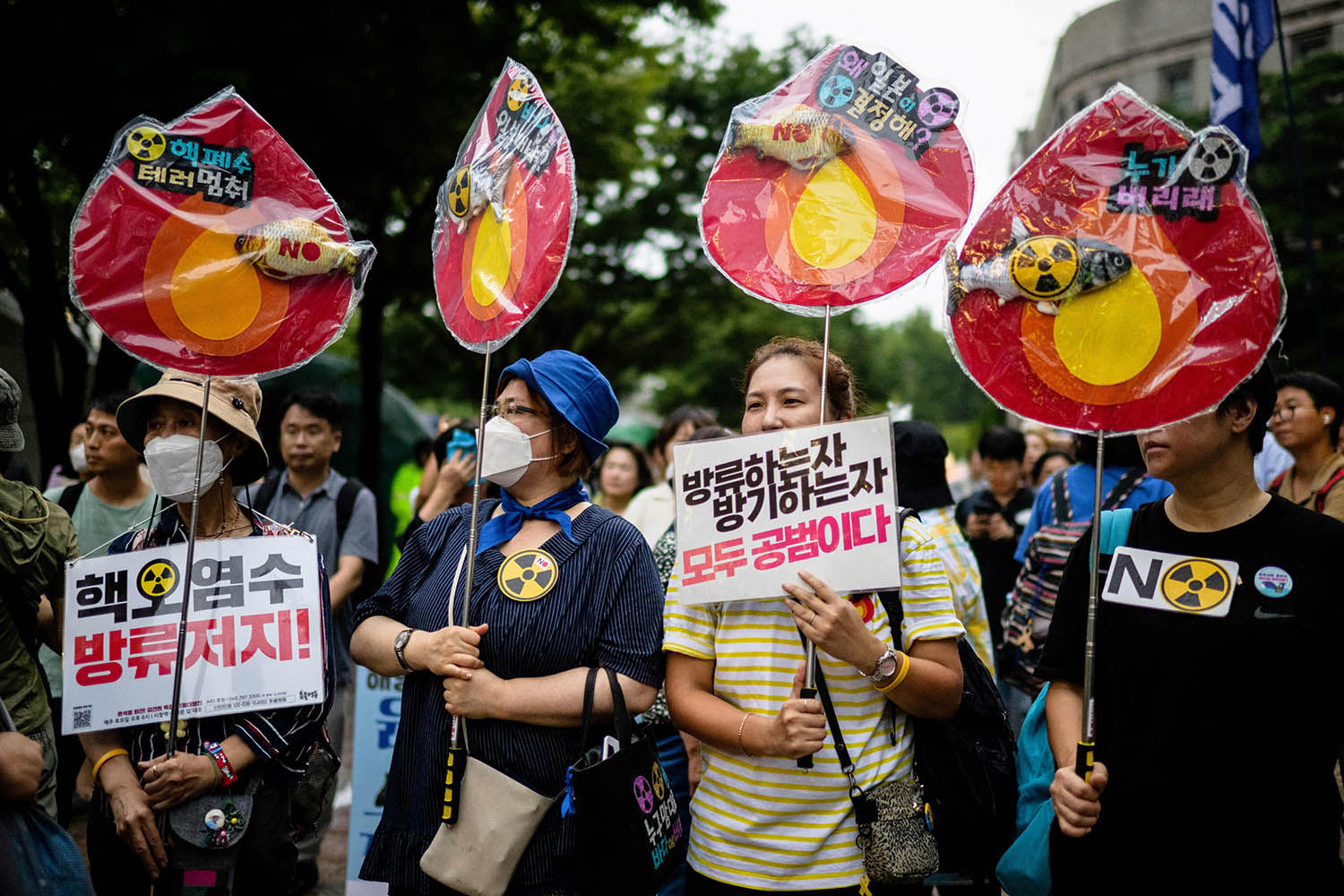
- Friends. South Korea stands alone among Japan’s neighbours in approving the discharge plan, but yesterday 16 people were arrested outside the Japanese embassy in Seoul after unfurling a banner reading “The sea is not Japan’s trash bin”. A recent poll found 84 per cent of South Koreans oppose the release, and opposition politicians accuse President Yoon Suk Yeol of sacrificing the nation’s health for a closer relationship with Japan. Communities in Taiwan and the Pacific Islands aren’t happy either.
Bad comms. Criticism from China was inevitable, but Japan’s failure to involve more stakeholders in the consultation process looks shortsighted. Greenpeace says other viable alternatives, such as long-term geological storage, weren’t given sufficient consideration. Consent-based approaches to burying toxic waste have had success in Canada, Finland and Sweden – but they can take up to 30 years to yield a solution.
Conventional nuclear power based on fission is low-carbon. But to prove its worth as a weapon in the fight against climate change, industry and governments still have to find ways to solve the waste problem quickly and transparently. Zero-waste fusion power is getting closer, but it’s still a long way off.
Photograph Anthony Wallace/AFP via Getty Images