Putin boasted yesterday that Russia’s arms industry “is gaining momentum”.
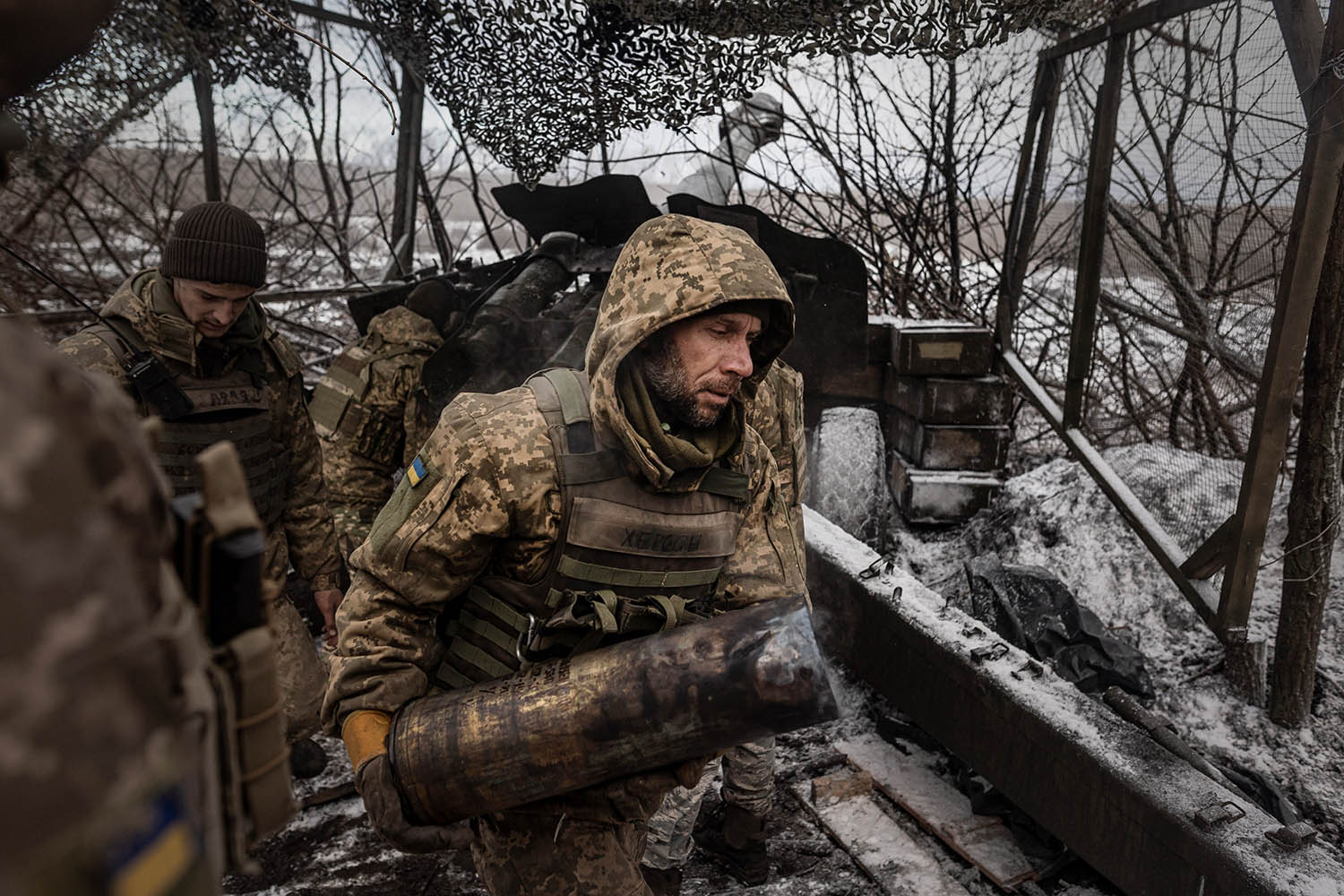
So what? He’s not wrong. Russia’s war economy is ramping up production of missiles and artillery shells as Ukraine’s supplies run dangerously low, mainly because a $61 billion US aid package is blocked in Congress.
Republicans want a deal on US-Mexican border security as the price of their support. The White House doesn’t want a deal on terms dictated by Republicans. As a result:
- Ukraine could soon run out of weapons.
- The stalemate along its 1000-kilometre front line could turn into a retreat.
- That could bleed support from Ukraine’s other allies, leading to defeat.
As David Cameron said in Washington last week, anything less than a sustained Ukrainian offensive is a win for Putin.
Walk-out. Before Cameron’s visit, Ukraine’s President Zelensky was scheduled to address a Senate briefing on US aid to Ukraine, Israel, Taiwan and Gaza. Republicans wanted to talk about the Mexican border instead. When urged to focus on the agenda, they walked out. The next day the Senate failed to pass the $110 billion National Security Supplemental Appropriations Act for 2024, of which the Ukrainian aid package is a part. Every Republican voted against it.
Demarche. Zelensky had cancelled his appearance in advance – a smart decision, Ukrainian MP Oleksandra Ustinova tells Tortoise, since otherwise it might have looked as if the Republicans were leaving the briefing “not because of the [Mexican] border but because of Ukraine”.
Big hope. Ustinova and other Ukrainian MPs close to the negotiations say from their point of view the appropriations bill ticks the right boxes: it contains everything the Biden administration asked for on Ukraine, with some additions from the Senate. If Democrats agree on the border compromise, Ukraine will receive exactly what it needs.
Big if. Biden has said he’ll get stuck into border talks this week but the two sides are still far from agreeing terms. Moreover the new Republican House Speaker, Mike Johnson, says the White House has failed to address his caucus’s concerns about
- the lack of a clear strategy in Ukraine;
- a path to resolving the conflict; or
- a plan for “adequately ensuring accountability for aid provided by American taxpayers”.
In reality, Ukraine’s military commander General Valery Zaluzhny has spelled out what he needs for military success; and Shalanda Young, the White House budget director, has made clear that almost half the $61 billion would be used to make weapons in the US. But every day it isn’t approved raises the stakes for Kyiv.
The money. Between August and October, overall aid to Ukraine fell to its lowest level since the invasion, 90 per cent lower than in the same period last year.
The alarm. “We are out of money – and nearly out of time,” Young wrote in a letter to Republican and Democratic leaders last week. Since then:
- Antony Blinken, the US Secretary of State, has said the Senate’s failure to approve support for Ukraine will “open a Pandora’s box of aggression around the world”.
- Andriy Yermak, head of Zelensky’s presidential administration, has said a failure to secure more US aid would mean a “very high possibility” of losing the war.
The politics. Republicans in DC argue that with an expected $2.5 trillion deficit this year the US shouldn’t be borrowing from China to give to Ukraine. But Cameron and Michael McFaul, a former US ambassador to Moscow, say the cost of stopping Russia now would be dwarfed by the cost of waiting.
Strategic cost. Funding delays affect Ukraine’s battlefield position immediately: they put future operations to regain lost territory in doubt, and they force Ukraine to conserve what it has rather than take the fight to the invaders.
Ukraine is at the mercy of a domestic argument about American immigration – unless and until Europe sheds the habit of a century and takes responsibility for its own security. That depends on unblocking €50 billion held up by an argument between Hungary and Brussels that will be at the top of the agenda at an EU summit later this week.
Watch this space.
Further reading:Europe must urgently prepare to deter Russia without large-scale US support by Professor Justin Bronk