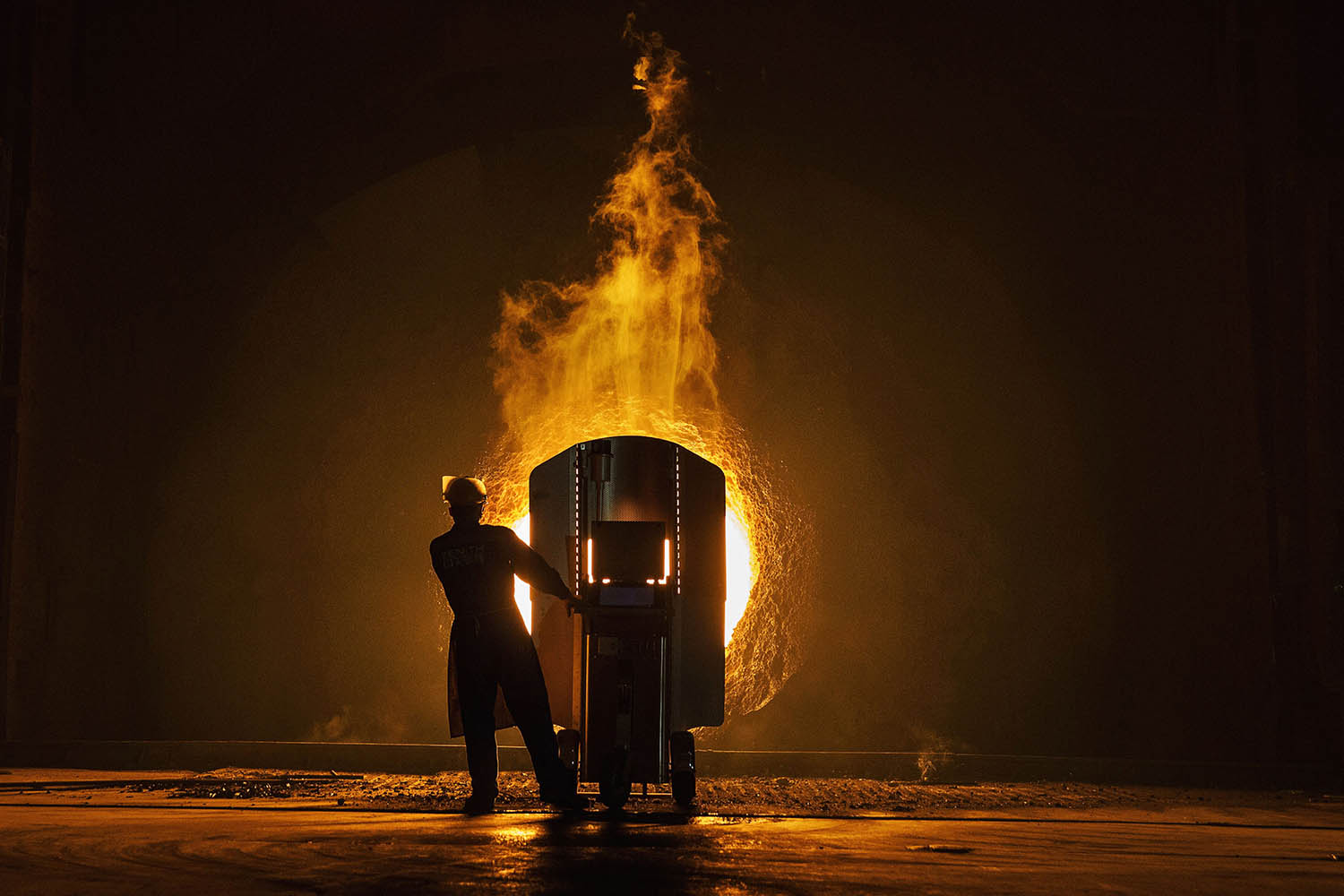
There is nothing glamorous about the EU’s new rules on the embedded carbon content of cheap imports – but they could go a long way towards saving the planet
This month, for the first time, Chinese steel mills are having to report the carbon footprint of any steel they want to sell in the EU.
So what? It’s a chore, it’s a cost and it may accelerate the break-up of an economic relationship that has been an engine of prosperity for two billion people for three decades. It may also help save the planet.
CBAMboozle. The EU’s carbon border adjustment mechanism (CBAM) is a mouthful and still only in pilot form but it addresses a source of greenhouse gases four times more polluting than aviation.
Levy metal. Iron and steel account for 8 per cent of global CO2 emissions. Steel alone accounts for 22 per cent of Europe’s industrial CO2. China produces more than half the world’s steel – more than a billion tonnes last year, up tenfold from the turn of the century – and the EU is its biggest importer.
- If Chinese steel were made with renewable power this wouldn’t be a problem.
- But most of it is made with fossil fuels. New Chinese steel capacity equivalent to Germany’s entire production has been approved every six months for the past six years, according to Wood Mackenzie, the energy consultancy. The new plants have a 40-year lifespan and 90 per cent of them run on coal or gas.
- When the EU imports this steel, it imports embedded emissions.
- End users like it because it’s cheap, but European producers don’t because it undercuts them, and anyway it’s considered “carbon leakage”, undermining EU efforts to get to net zero.
- Hence the CBAM, an EU border levy to stop the leakage, do right by European steel makers and encourage their Chinese competitors to go green.
How it works. The CBAM is a bare-bones version of the “carbon club” idea popularised by Yale’s William Nordhaus. It requires anyone exporting iron, steel, aluminium, cement, hydrogen, fertiliser or electricity to the EU to a) measure, b) report and c) pay for its embedded carbon. So far Brussels is only requiring a) and b); c) kicks in in 2026 and the UK is expected to introduce its own scheme in 2027.
How it looks. That depends on your point of view.
- CBAM advocates say it’s a stick-and-carrot way of spreading EU emissions targets worldwide: decarbonise your steel production with renewably-powered electric arc furnaces rather than old-fashioned blast furnaces and you can sell to Europe at no premium. Fail to do so and you will have to pay for permits to pollute.
- Wood Mackenzie’s Isha Chaudhury says it serves fairness: the CBAM “will significantly rebalance the steel trade,” raising the European price of Chinese steel imports by around 25 per cent.
- Some Chinese producers say it’s green protectionism.
Hypocrisy? The CBAM is vulnerable to the charge of being yet another way of forcing developing countries to pay for climate clean-up necessitated mainly by developed ones. And yet…
- unlike the fantasy of a united world government and a globally-enforced carbon price, this is a practical response to a colossal challenge; and
- there are signs that it’s already working as intended: the FT reports that Beijing is prioritising research and cooperation to lower the carbon intensity of its steel.
No surprise there. Self-interest appears to be driving China to act fast, not least because other players including Australia, Qatar and Saudi Arabia (with access to low-carbon feedstocks and unlimited solar power) may be better-placed to exploit the new rules.
The race to decarbonise steel is on, and EU regulators fired the starting gun.
End note. The CBAM doesn’t apply to manufactured goods, including electric cars made with cheap Chinese steel. Europe is bracing itself for a wave of Chinese EV dumping to which it so far has no answer.