
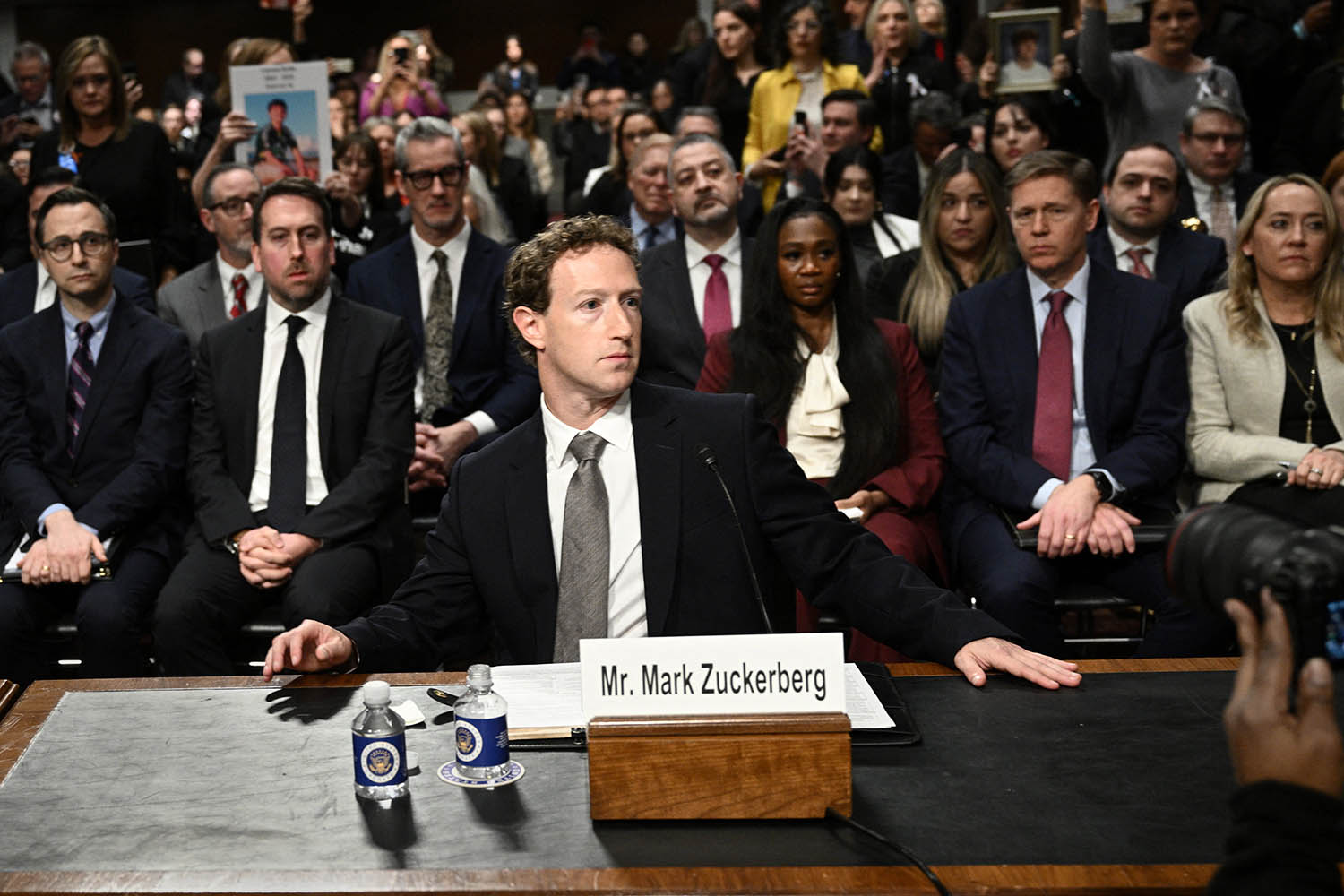
US Congress wants tech titans to take more responsibility. This could challenge Silicon Valley's belief in free speech absolutism
Twenty years ago Mark Zuckerberg apologised to Harvard students after uploading their pictures to his first website, Hot or Not. “I hope you understand, this is not how I meant for things to go,” he wrote, “and I apologise for any harm done as a result of my neglect.”
So what? Last week he apologised again, this time to parents of children whose sexually explicit images were uploaded to Instagram, and who suffered drug-related deaths thanks to his sites, or who were harmed by Meta’s addictive features.
“I’m sorry for everything you’ve all gone through, it’s terrible,” he said as the TV news teams rushed in. “No one should have to go through the things that your families have suffered.”
Sorry not sorry. Zuckerberg’s apologies are legion and have generally – and skilfully – conveyed detached regret about technicalities, not personal remorse for people’s suffering. For instance:
- In 2007 for violating millions of Facebook users’ privacy by publishing information about their online shopping: “We’ve made a lot of mistakes building this feature, but we’ve made even more with how we’ve handled them… and I apologise for it.”
- In 2017 after a tasteless virtual reality tour of Puerto Rico in the immediate aftermath of Hurricane Maria: “I’m sorry to anyone this offended.”
- In 2016 after the Cambridge Analytica scandal that ensnared him in Brexit: “We have a responsibility to protect your data, and if we can’t then we don’t deserve to serve you.”
Host story. If such conditional mea culpas strike many of those harmed by contact with Facebook as insincere, that may be because they’re underpinned and undermined by Silicon Valley’s one true religion: an absolute belief in the right to host whatever people want to put on the internet and to suffer no regulation or punishment as a result.
White and black. Jason Goldman, who helped found Twitter, says tech titans think of speech as binary – free or not – because most of them trained as engineers. A lack of exposure to the humanities makes for poor training in nuance. He believes the obsession with free speech that drives the mostly white, male members of the tech elite is a function of having made their billions when most of the industry looked and thought like them.
Tackling diversity through free speech absolutism is “an engineering solution to a political problem,” Goldman says.
Section 230. Until now, Congress has backed the engineers with a piece of legislation on which the entire social media ziggurat rests.
- Section 230 of the 1996 Communications Decency Act separates websites from publishers – stating “no provider or user of an interactive computer service shall be treated as the publisher or speaker of any information provided by another information content provider.” In other words, unlike legacy media, they can’t be held responsible if their users incite acts of terror or distribute child pornography.
- For years, Silicon Valley assumed Democrats afraid of right-wing misinformation would pose the most serious threats to their view of free speech and to Section 230. That is changing.
Eyes right. Testifying on Capitol Hill, Zuckerberg was attacked by conservative senators of different stripes, for different reasons. It was the Republican Josh Hawley who demanded he apologise last week. Hawley has just filed an amicus brief to the Supreme Court in support of a Texas law preventing tech companies censoring conservative views. In doing so, he challenges Section 230 immunity.
The walls are closing in. Zuckerberg faces an increasingly complex set of political problems. The EU, UK, Australia, Brazil, Canada, and South Korea are all passing laws to regulate social media, while in the US
- 42 states are suing Meta; and
- dozens of state laws attempting to exert some form of control over the platforms are making their way to the Supreme Court.
What’s more… The quest for protection against online child harm is one issue that gets bipartisan support in Washington. Federal regulations may be considered, and Silicon Valley fears regulation creep.
In the meantime an asset Zuckerberg used to take for granted is dissolving. In a chatroom conversation captured during the platform’s start-up days, he boasted that users handed over personal information because “they ‘trust me.’ Dumb f—ks.”
Not any more.