
Joe Biden says he hopes a ceasefire in Gaza can be reached by Monday
The signs had been positive for several days. There was progress in Paris at the weekend. The talks then moved to Qatar, and now Joe Biden says a ceasefire between Israel and Hamas could be in place by Monday.
So what? Talk is cheap, but after four months of carnage with only one pause, a deal is in prospect that could at least postpone Israel’s threatened ground offensive in Rafah.
Israel says Rafah is the last Hamas military stronghold. It’s also a temporary home to more than a million Gazan refugees with nowhere further south to go.
A deal would require
- Hamas to release some or all of the 130-odd hostages it still holds;
- Israel to suspend its Rafah threat and release an agreed number of Palestinian prisoners; and
- both sides to move further in private than they have in public.
It could easily not happen. This standoff is between a Hamas leadership demanding full Israeli withdrawal as a precondition for a hostage deal, and an Israeli leadership demanding the release of all surviving hostages as a precondition for even a temporary ceasefire.
The US could force Israel’s hand. It hasn’t done so. Instead, alone among UN Security Council members, it has vetoed three UN ceasefire resolutions.
But principals and sherpas are now raising rather than lowering expectations.
- Jake Sullivan, the US national security adviser, says Israel, Egypt, Qatar and the US have come to an understanding on the basic contours of a “firm and final” agreement on a temporary ceasefire.
- Egyptian officials speak of a deal involving the exchange of 40 hostages for about 300 Palestinian prisoners and the full opening of the Rafah border crossing to aid.
Benjamin Netanyahu, the Israeli PM, says an offensive could be “delayed somewhat” by a ceasefire agreement, though he says a Rafah offensive is still inevitable unless all remaining hostages are home by Ramadan – which starts on 10 March.
About that offensive. It would aim to eliminate any remaining Hamas battalions, and probably kill the Hamas military leader Yahya Sinwar. In the process it would turn Gaza’s crowded southern border zone – to which Israel has previously advised civilians to retreat for their own safety – into an active battlefield; and force those trying to escape to head north or south.
To the north the UN says 80 per cent of homes are damaged or destroyed and children are starving. To the south lies the Egyptian border, closed to refugees.
About that veto. The latest UN Security Council resolution on Gaza called for an immediate and unconditional ceasefire after the deaths of nearly 30,000 civilians there. The US vetoed it, and the UK abstained, because unlike the US alternative it didn’t require a deal on hostages and would have left Israel without leverage to secure their release.
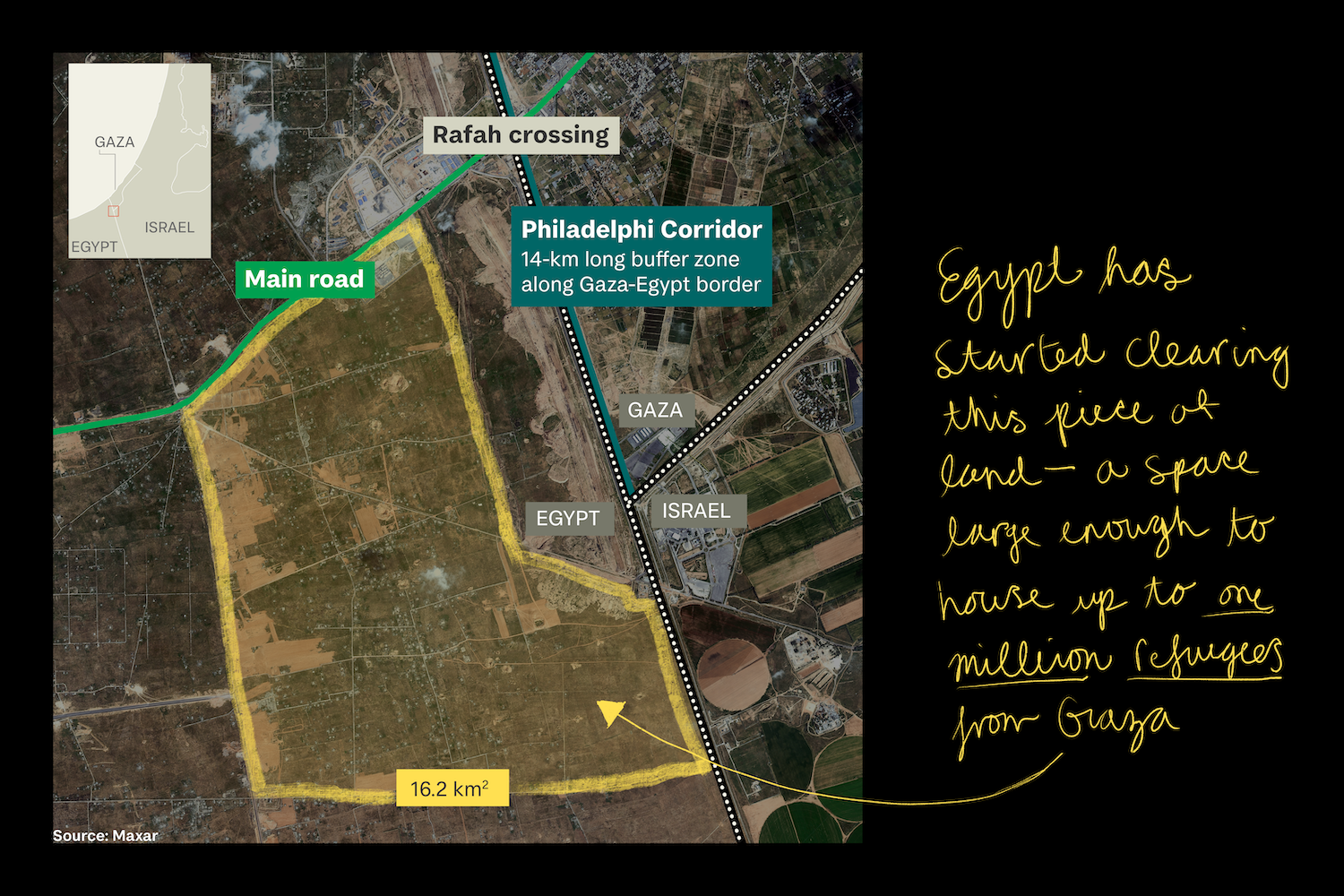
Corridor of power. Israel seeks leverage outside Gaza as well – in the Philadephi Corridor, a 14-kilometre buffer zone 100 metres wide that runs between Gaza and Egypt. Israel relinquished control in 2005 but now wants it back, and Egypt is alarmed:
- Netanyahu has said he’ll offer refugees safe passage out of Rafah before any ground offensive .
- The UN says there’s nowhere safe for them in Gaza.
- So Egypt’s President Sisi fears Israel will let them cross the corridor instead – which he can’t allow without seeming complicit in another Palestinian nakba, or catastrophe.
A breakout “would have severe consequences for the security and stability of the region,” an Egyptian official tells Tortoise. This may account for some contingency planning on the other side of the border.
Mystery enclosure. Satellite images show the construction of a high wall in the buffer zone. There’s been speculation it’s meant to contain a sudden influx of displaced Palestinians, but Cairo claims it’s a base for trucks forced to wait days or weeks bringing aid to Gaza. Either way, it’s new.
In 1981, Reagan suspended F-16 deliveries to Israel after it bombed Iraq. In 1991, the first President Bush made Israel’s Yitzhak Shamir sit down with Palestinian leaders in Madrid to try to “put an end to the Arab-Israeli conflict”.
There is no sign yet of Biden taking a similarly tough line – but every sign he’ll have to if there’s no deal by next week.
Additional reporting by Magdy Samaan
More than 70 countries are holding elections this year, but much of the voting will be neither free nor fair. To track Tortoise’s election coverage, go to the Democracy 2024 page on the Tortoise website.