
Boeing has announced sweeping changes to its leadership team including the departure of its chief executive as it struggles to contain a spiralling safety crisis.
So what? Safety problems at an aircraft manufacturer are like dirty scalpels in an operating theatre. Those engulfing the maker of the 737 – the latest of which involved a door blowing off mid-flight – raise questions about a company culture that appears to prize cost-cutting and financial returns over engineering excellence.
Boeing’s CEO, Dave Calhoun, is leaving at the end of this year and its head of commercial planes is retiring immediately, the company said yesterday.
Three strands run through this story:
- Safety versus returns. When Boeing merged with rival McDonnell Douglas in 1996, the leaders of the smaller company – and their culture – emerged on top. Boeing’s in-joke had been “we hire engineers and other people”. The emphasis shifted to boosting the stock price and to directors’ rewards tied closely to it.
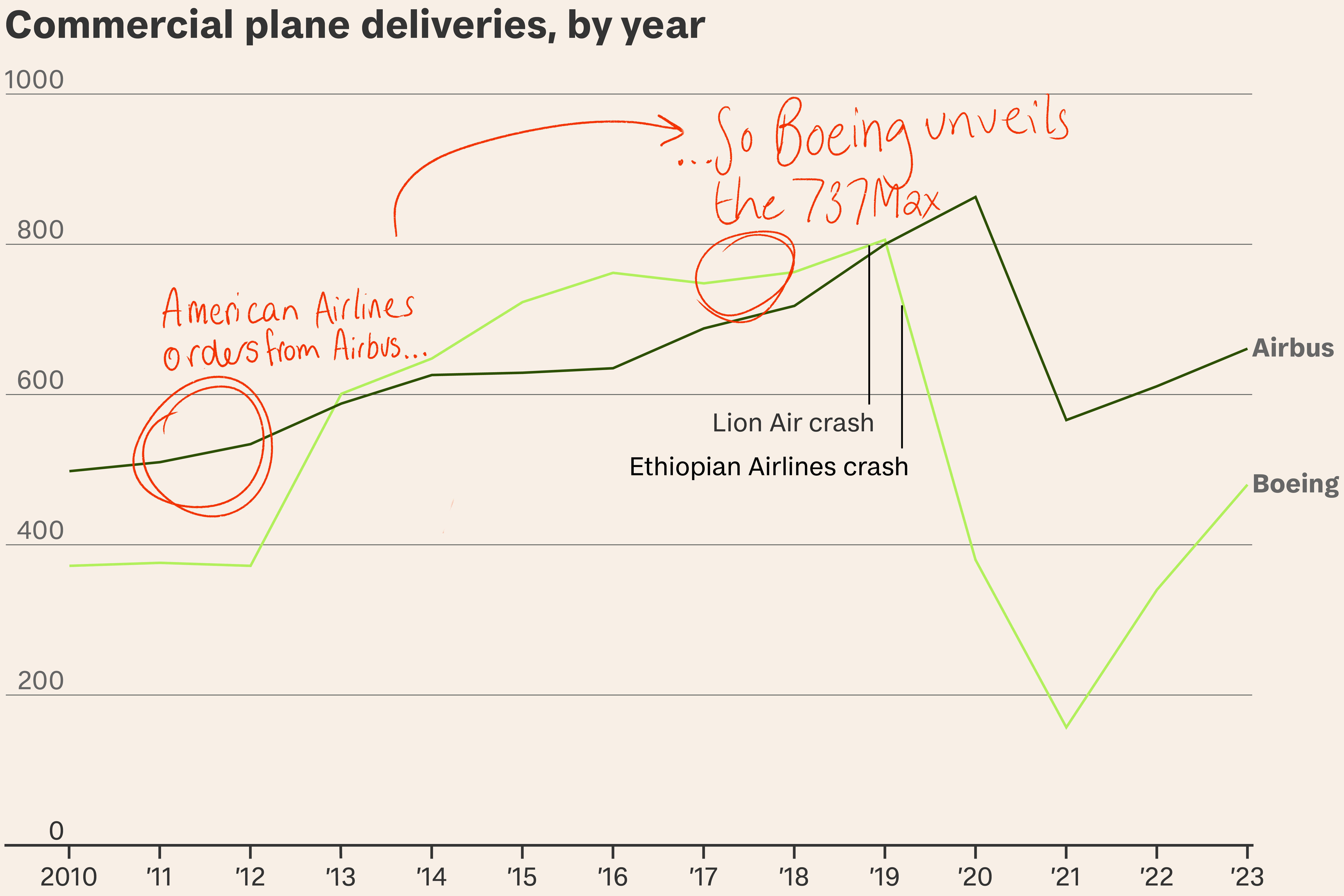
- Competitive pressure. In 2011, Airbus broke Boeing’s monopoly at American Airlines, winning a blockbuster order for its fuel-efficient rival to the 737, the A320neo. This spurred Boeing to develop a new version of the 737 – the Max – with bigger engines mounted further forward on the wings. Unveiled in 2017, this became one of its most popular models.
- Oversight. The US Federal Aviation Administration (FAA) agreed with Boeing that pilots who had flown the older 737 didn’t need flight simulator training for the new model. Instead, it approved the far cheaper option of training using a tablet computer. Peter Robison, author of Flying Blind, an account of several 737 disasters, identifies a number of “revolving door” cases in which FAA managers monitoring Boeing have left to get jobs at the company.
Trimming like crazy. One consequence of adding new engines to an existing model – rather than undertaking the long and costly process of redesigning the whole plane – was a tendency for its nose to tilt up. Boeing’s solution was software that automatically pushed it down – sometimes too far. The problem was spotted in development by a pilot who noted: “the plane is trimming itself like crazy… I’m like, WHAT?”
Black lives don’t matter. When Lion Air Flight 610 crashed in Indonesia in October 2018, killing all 189 on board, Boeing didn’t ground the 737 immediately. After Ethiopian Airlines flight crashed in March 2019, killing 157 people, it was China that did so first, followed by regulators in Asia and Europe. The FAA waited three days. When Calhoun became CEO in 2020 he gave an interview appearing to blame the Indonesian and Ethiopian pilots for not having “anywhere near the experience they have here in the US”.
Spinning out. Boeing’s fuselage-making division, Boeing Wichita, was divested in 2005 to cut costs. The spun-out company, Spirit Aerosystems, supplies the fuselage for the Max. An investigation into the door panel that blew off mid-flight in January found multiple cases of both companies allegedly failing to comply with quality control requirements. The US Department of Justice has opened a criminal investigation.
What next? Airbus, which has taken the lion’s share of the commercial jet market since the Lion Air crash, could exploit the crisis to cement its dominance, taking the time to develop more fuel-efficient planes without pressure from its rival. And there’s another challenger: the Commercial Aircraft Corporation of China has just four of its C919 planes in service competing with the 737. But Airbus started small too.
National ex-champ. Boeing is – or was – an icon of US manufacturing and a mainstay of the S&P 500. As a military contractor it’s still vital to the Pentagon, but having emphasised financial over mechanical engineering its outgoing leaders have failed on both fronts.
What’s more… one former supplier to Boeing said last week its image would take two decades to repair.