
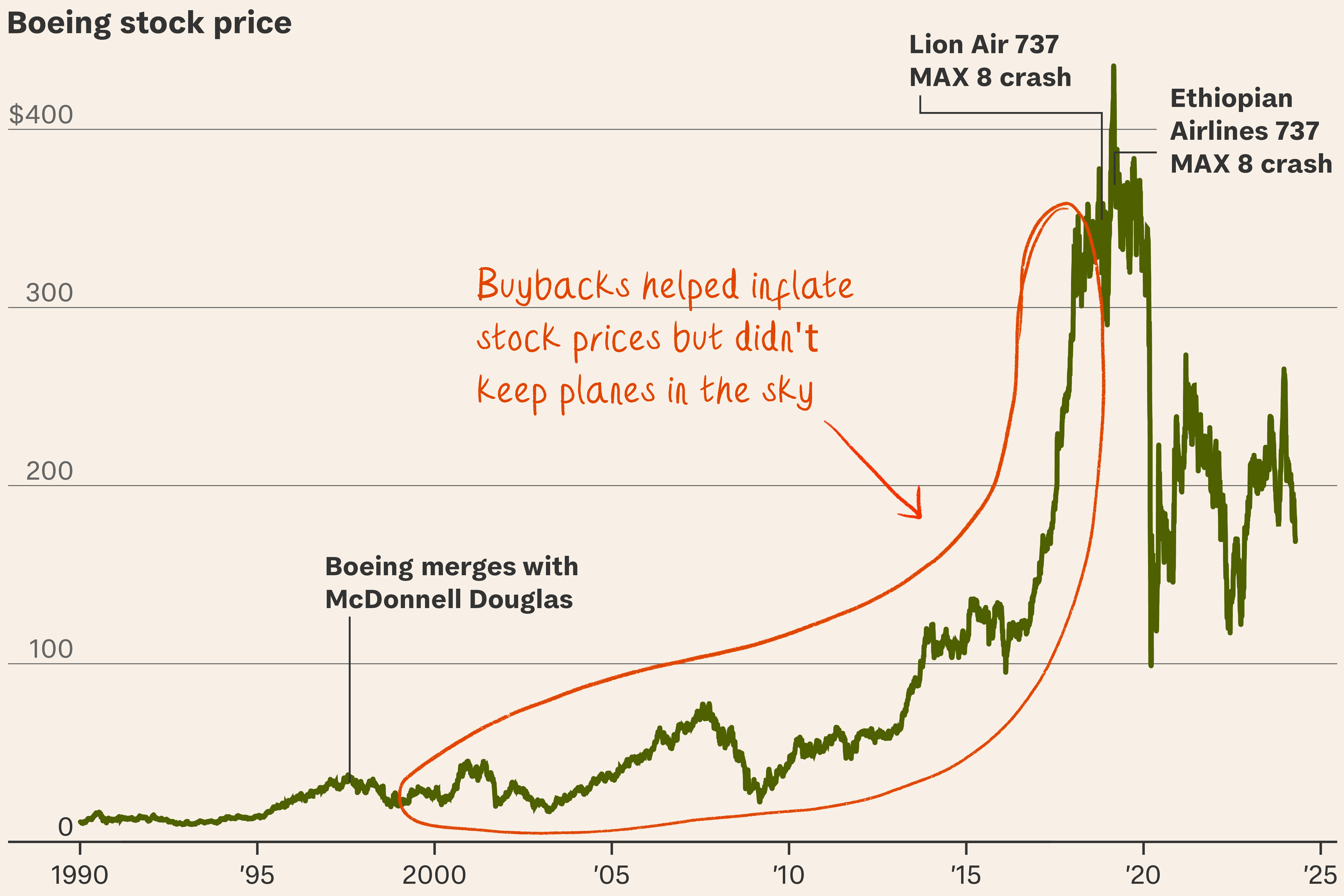
The fallout from the crashes of 2018 and 2019 isn’t over. In fact it may be getting worse.
Last week a whistleblower testified to the US Congress that “unless action is taken, and leaders are held accountable, every person stepping aboard a Boeing airplane is at risk”.
So what? After two crashes five years ago, Boeing was supposed to have strengthened its quality controls and reassured the public that it had prioritised safety over profits. The signs are it hasn’t.
The whistleblowers invited to address the Senate Homeland Security Committee claimed that
- Boeing’s 737 Max 8, which crashed in October 2018 and again in March 2019, is still not safe;
- Boeing management is guilty of a “criminal cover-up” of documents linked to an accident in January; and
- the company is taking shortcuts on its 787 production line that could impact the plane’s safety and lifespan.
The caveats. Boeing denies taking shortcuts and says it’s “fully confident” in the 787. Also worth noting: an American Airlines 737 pilot with experience of the software system blamed for the Max 8 crashes says it has been fixed, and the global 787 fleet has completed 4.2 million flights with no fatal incidents.
And yet. The company’s long and costly effort to repair its reputation isn’t working.
Max 8 safety. Multiple investigations by Congress, the Federal Aviation Administration and US news outlets found that before the 2019 crash of Lion Air Flight 610 in Indonesia, Boeing had not given pilots proper training in how to fly with the MCAS software package installed to correct a nose-up tendency caused by the 737 Max 8’s powerful new engines.
On the contrary…
- Boeing hadn’t given pilots any training on the new system.
- In fact it had leaned on the FAA to remove any mention of the system in the pilots’ handbook, except in a list of abbreviations.
- And it had made the system dependent on a single sensor, with the result that if the sensor failed the plane could be forced into a nose-dive. As Captain Dennis Tajer of the Allied Pilots Association says: “It was relentless. The only limit it had was until it killed you.”
Max 9 safety. The corporate culture that led to the Max 8 crashes also led to the blowout of a door on an Alaska Airlines 737 Max 9 at 16,000 feet in January this year, according to Ed Pearson, a former FAA and Boeing engineer. That culture involved “chaotic manufacturing” and a “dysfunctional safety culture” compounded by a “horrible job” by the government agencies that investigated the crashes – chief among them the FAA itself, which by 2018 had outsourced 98 per cent of Boeing safety inspections to Boeing’s own engineers.
Payoffs, by the numbers
$62 million – stock options and other benefits paid to Dennis Muilenberg, CEO at the time of the crashes, as he left the company.
45 per cent – pay rise awarded to Dave Calhoun, the outgoing CEO, after the Alaska Airlines incident. He’ll leave with options worth up to $33 million if Boeing’s share price recovers.
$209 million – approximate total value of salary, bonuses and options paid to James McNerney, who ran the company for ten years during which it stands accused of deceiving markets and suppliers about the 787’s readiness to fly.
Trust. Once one of the most trusted names in business, Boeing isn’t any more. “The benefit of the doubt is running extraordinarily thin,” says Captain Tajer.
Nightmareliner. The 787 Dreamliner might have funded a replacement for the 737 Max series, which was itself a cost-saving alternative to a new design. Instead it has funded lavish compensation for Boeing executives while whistleblowers allege shoddy practice in the South Carolina 787 assembly plant. One says he found a ladder left inside a tail.
What’s more… Airbus is now producing nearly 50 per cent more planes per year than Boeing. One source who used to supply both companies says the rot set in at Boeing when it merged with McDonnell Douglas 20 years ago, and will take another 20 to clear out.


