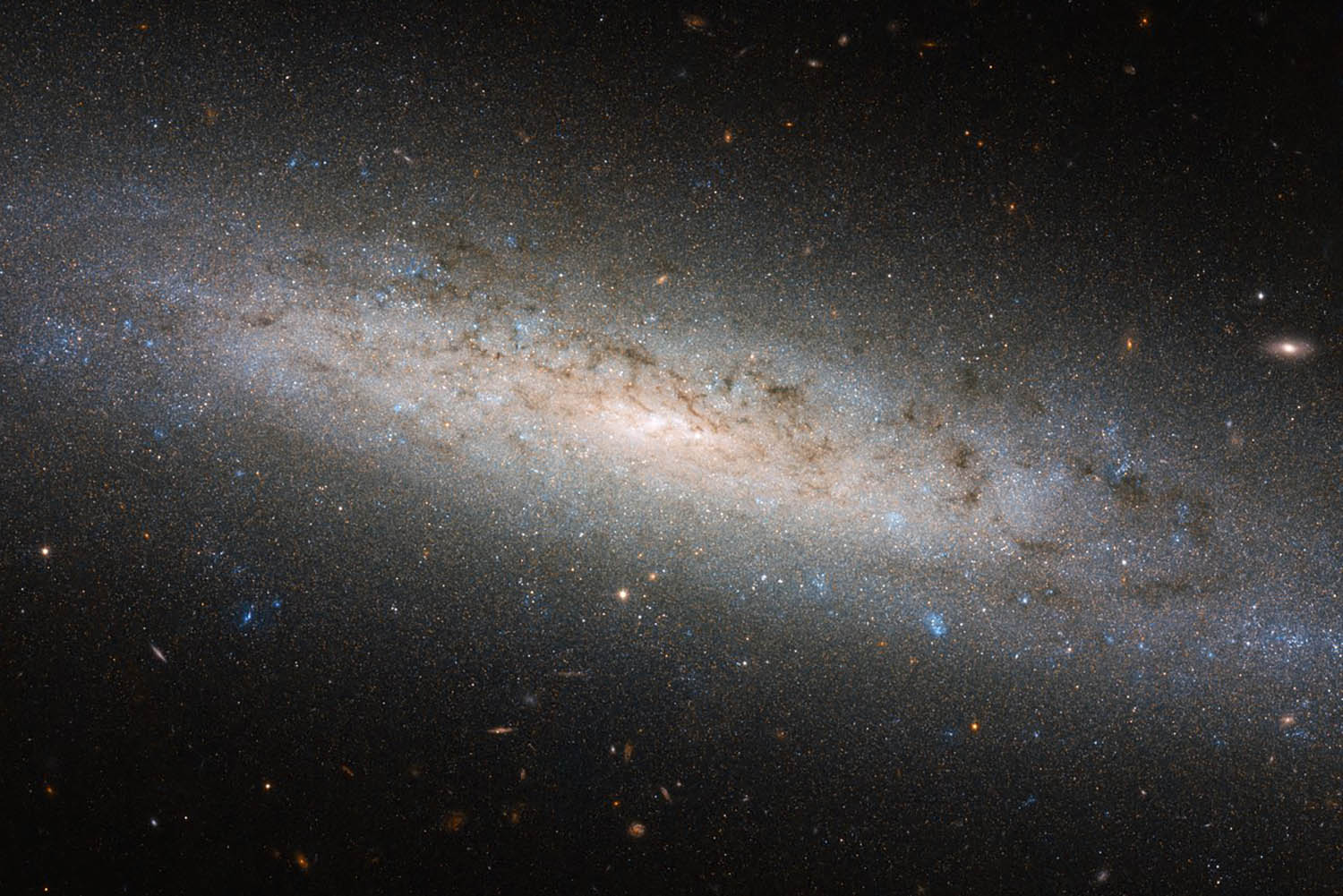
For 40 years, scientists who don’t believe in dark matter have had a plausible alternative explanation for the peculiar behaviour of galaxies.
So what? They don’t any more. Two UK-based cosmologists have published studies that strengthen the case for dark matter by shaking the foundations of a rival theory known as Modified Newtonian Dynamics, or Mond.
This is a step towards proof of the existence of dark matter, which would
- explain why galaxies spin as fast as they do;
- account for 95 per cent of the energy and mass in the universe, all of it invisible to humans;
- probably involve the discovery of an exotic new particle outside the standard model of physics; and
- unquestionably win a Nobel Prize.
But first there’s a process of elimination to complete.
The problem is that dark matter remains no more than a theory, offered in the 1930s to account for the fact that the outer edges of galaxies rotate faster than Newtonian physics can explain – unless they’re held together by the gravitational pull of prodigious pools of mass and energy not interacting with any known particles (hence dark).
A solution offered by the Israeli physicist Mordehai Milgrom in 1983 suggested that in fact gravity operates differently when weak, for example at the remote edges of galaxies and systems of galaxies. This was Mond, adapting Newton to do away with the need for dark matter as an explanation for the shape of the universe.
Enter Cassini. If Mond were valid it would show up in small but measurable anomalies in nearby planetary systems like Saturn and its moons, orbited by the Cassini probe for 13 years. Cassini mapped Saturn’s long orbit round the sun with extraordinary precision and would have spotted the slightest deviation caused by Mond. But when Dr Harry Desmond of the University of Portsmouth studied Cassini’s findings, he found none.
“It’s not the end of the line for Mond, but it adds more credence to the idea that there’s no modification to gravity in the solar system,” Desmond says, modestly. As he writes in the Conversation, the chances of Mond matching Cassini’s result were in fact the same as a coin landing heads up 59 times in a row.
If not Mond? Then probably dark matter.
The view from Lagrange Point L2. Another way of testing for modified gravity and the Mond system in action is by looking at pairs of “binary” stars rotating round each other. According to Mond, they should rotate up to 20 per cent faster than Newtonian physics allows – and Dr Idranil Banik of the University of St Andrews thought they would do just that.
Dr Banik was a Mondian. “For ten years I was passionately advocating the view that galaxies don’t have dark matter,” he says. He isn’t any more. After studying mountains of data from the Gaia space telescope, which peers into space a million miles from Earth and has been looking at binary star pairs for ten years, Banik found not a single Mond anomaly.
The proof of dark matter’s existence will be found in one of three ways, Benson says:
- In particle experiments in instruments like Cern’s Large Hadron Collider.
- By “direct detection” in vats of noble gases designed to detect strange new particles.
- Or by indirect detection using telescopes to look for dark matter particles on the theory that they might emit faint light when colliding with each other.
Banik adds a fourth: by studying the heavens for “tidal streams” left by dwarf galaxies as they plough through dark matter wreathing the Milky Way. But he isn’t waiting for proof, having already been forced “to consider the universe very differently” and to side with those he used to think mistaken.
A timely parable about respect for evidence and the scientific method? Absolutely.
What’s more… his colleagues aren’t waiting to suggest names for yet-to-be discovered dark matter particles. One is the ‘weakly interacting massive particle’, or WIMP.