Sensemaker Daily


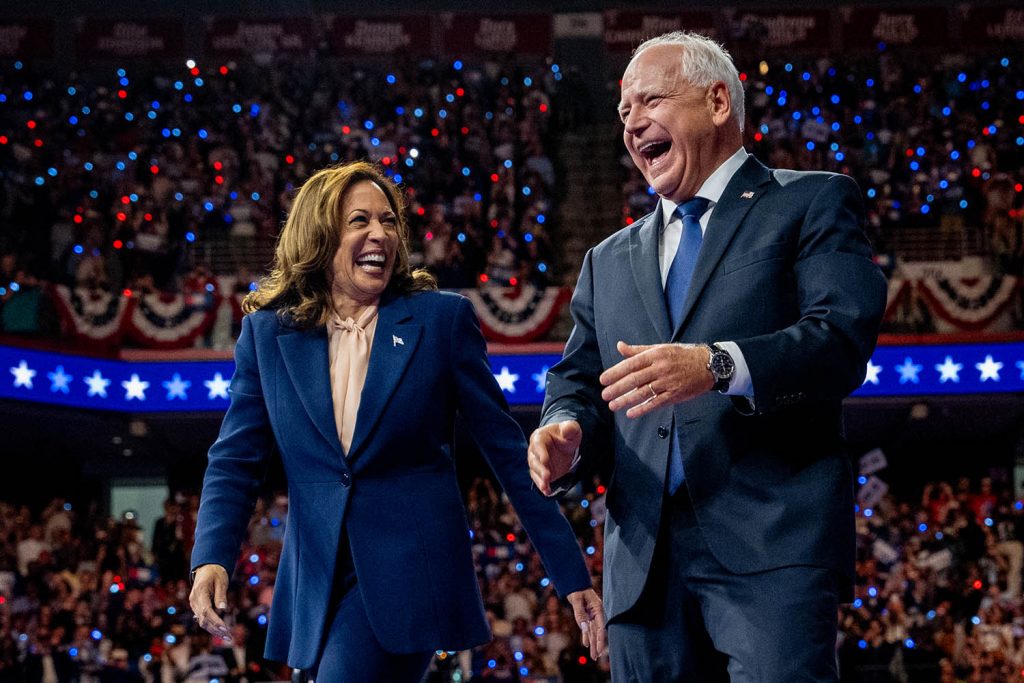
Last week, Tim Walz was a relatively obscure governor from a relatively blue US state. Last night, he stepped on stage in Philadelphia as Kamala Harris’s running mate and was suddenly 93 days, 270 electoral college votes and one heartbeat away from the presidency.
So what? The choice of running mate doesn’t normally affect the outcome of a presidential election. But this isn’t a normal election.
Harris officially secured the Democratic nomination for president on Monday in an online roll call of delegates, a fortnight after Joe Biden withdrew from the race and a fortnight before the party’s convention in Chicago on 19 August. The choice of Walz suggests that Harris’s campaign is:
- more concerned about keeping young voters on side than winning specific swing states;
- focused on preserving party unity during an exceptionally short presidential run; and
- looking for the “joy vote” to inspire the few undecided voters left in America.
Home field advantage. The other top contenders to become Harris’s running mate were mainly from swing states – like Pennsylvania Governor Josh Shapiro or Arizona Senator Mark Kelly.
Academics have found that having a vice president from any given state tends to have a positive – but small – electoral impact in that state. Last month, data analyst Nate Silver estimated that having a VP from Pennsylvania would improve a ticket’s margin there by 0.4 percentage points. Others put the home state advantage slightly higher, at closer to 2 points.
- Harris is currently leading Donald Trump by 1.7 per cent, according to FiveThirtyEight national polling averages; and
- in 2020 Biden won Pennsylvania by 1.2 per cent; Wisconsin by 0.63 per cent; Arizona by 0.31 per cent and Georgia by 0.24 per cent.
- With margins like these, anything could be the extra push that matters.
People were confident that Shapiro could win Pennsylvania – and its 19 electoral college votes – for the Democrats, said Leslie Vinjamuri, director of the US and Americas programme at Chatham House. But adding him to the ticket risked losing some young voters that Harris’s campaign has begun to re-energise, in particular because of Shapiro’s sharp criticism of the pro-Palestine university encampments.
“You couldn’t quite name it in terms of a state, but you could see where there might be some problems,” she said.
Meanwhile, Walz’s star was rising. His original criticism of Donald Trump – “these guys are just weird” – went viral and has been adopted widely by Democrats.
Compare and contrast. Historically, the veepstakes have often been an exercise in finding contrast.
- Barack Obama was young (and Black); Joe Biden was older (and white).
- John McCain was a Washington insider; Sarah Palin was certainly not.
- John F. Kennedy was born rich in New England; Lyndon Johnson grew up poor in Texas.
In addition to being a white man, Walz is a native midwesterner born in rural Nebraska, which contrasts well against Harris’s liberal California vibes. He worked as a teacher for two decades, coached high school football and served in the Army National Guard before standing for Congress.
Since he was re-elected governor in 2022 and Minnesota Democrats won the state government, the 60 year-old has pursued distinctively progressive policies, including
- introducing free school meals;
- enshrining the right to abortion under state law; and
- expanding background gun checks.
That means Republicans can criticise Walz as “dangerously liberal”. But his background means he can unify both the moderates and the progressives within the Democratic party, as well as signalling “to working class Americans in swing states especially that… this is a team that actually speaks to their interests,” said Vinjamuri.
What’s more. Dan Baer, a former ambassador under Obama, said last month that Harris had “captured the joy vote” and her VP pick should lean into that. A resurfaced video of Walz at the Minnesota state fair last year with his daughter seems to fit the bill.