Sensemaker Daily


Anyone paying attention to the US presidential election knows this is the biggest week of Kamala Harris’s career so far. She starts the Democratic convention in Chicago with a narrow poll lead in the rust belt. As of yesterday she was either neck and neck with Trump or ahead of him across much of the sun belt too.
Her honeymoon has been rapturous for Democrats and bewildering for Trump. It puts her within touching distance of the White House, where she would be the first woman, the first Black woman and the first Asian woman in charge of the free world.
So what? It’s not enough.
Harris is on a roll, but male voters, non-college-educated White voters and the vexing structure of the US electoral college are still against her.
The roll. Momentum (in polls), buzz (in the media) and enthusiasm (Democratic voters are nearly twice as excited about her candidacy as they were about Biden’s), are going her way for now. And yet…
Those polls. Harris’s advances mask vulnerabilities that could undo her by election day. According to the non-partisan Cook Political Report polling average
- Trump is still further ahead with men nationally than Harris is with women;
- He has a 28-point lead over Harris among White non-college-educated voters compared with Harris’s 12-point lead among White voters with a degree;
- they’re in a statistical tie for the roughly 20 per cent of independent voters likely to decide the race (currently breaking 44.7 to 44.2 per cent for Trump); and
- Harris’s favourability ratings lag those of Biden at this point in 2020 and Hillary Clinton in 2016.
Political economy. Nothing Harris has said or done in the past month changes the fundamentals that have motivated Trump’s base for the past four years, during which average inflation-adjusted wages in the US have fallen by nearly 4 per cent. She set out the bones of an economic policy on Friday, including a $6,000 child tax credit – but that was in response to a $5,000 tax credit floated by the Trump-Vance ticket.
Political strategy. Harris has yet to decide whether to focus on reassembling the loose Democratic coalition that worked for Biden in 2020, or to target the blue collar voters who turned out for Clinton in 1992 and 1996 before defecting to Trump in 2016. She may favour an all-of-the-above strategy, but her broad brush approach to policy means no one really knows.
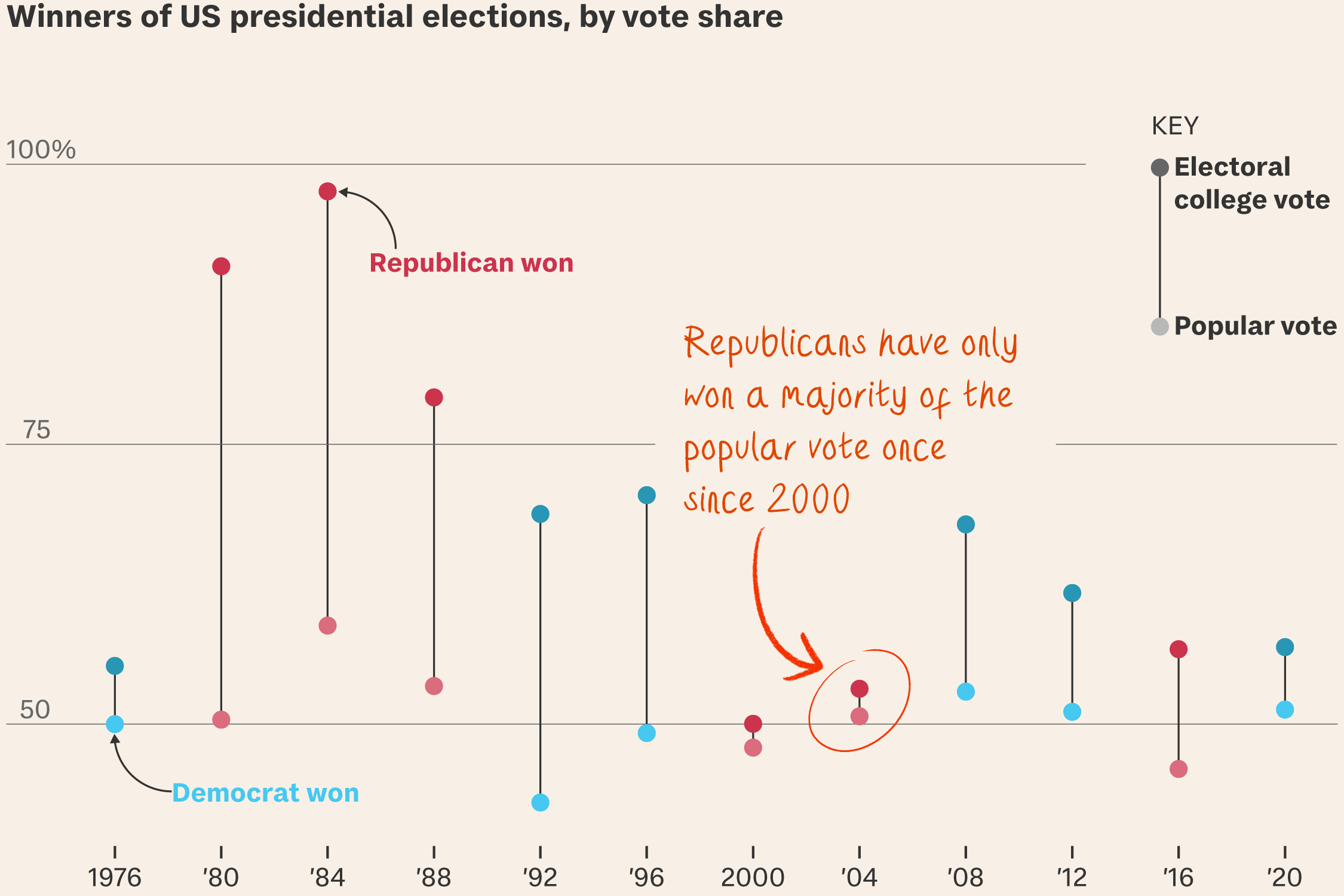
The map. America’s electoral map holds structural advantages for Republicans.
The number of electoral college votes for each state is calculated by adding its number of US House representatives (determined by population size) and its number of senators (two for each state). This means votes from smaller, more rural states are by definition more valuable than votes from larger states. Nothing illustrates this imbalance better than the fact that, since 2000, Republicans have won three presidential elections, but only in 2004 did they also win the popular vote.
So Kam she or not? Yes she Kam. She just has to
- hit a home run at the convention – which will be a coronation rather than a bun-fight thanks partly to more than 100 phone calls she made in 10 hours on the day Biden dropped out of the race to shore up support and enlist potential rivals;
- handle the press – she’s yet to hold a full press conference or sit for an in-depth interview since securing her nomination; and
- eviscerate Trump in the debates, in which he’ll paint her as a San Francisco liberal (which, for good or ill, is what she is).
No pressure then? Tremendous pressure. But so far, remarkably, she’s made it look as if it isn’t getting to her.
What’s more… the same can’t be said of Trump, who resorted on Saturday to telling a thinly-attended rally in Pennsylvania he was better-looking than his opponent.
Chart of the week