The process of choosing a new leader of the UK’s Conservative Party starts in earnest today with a first ballot of MPs to knock out one of six contenders.
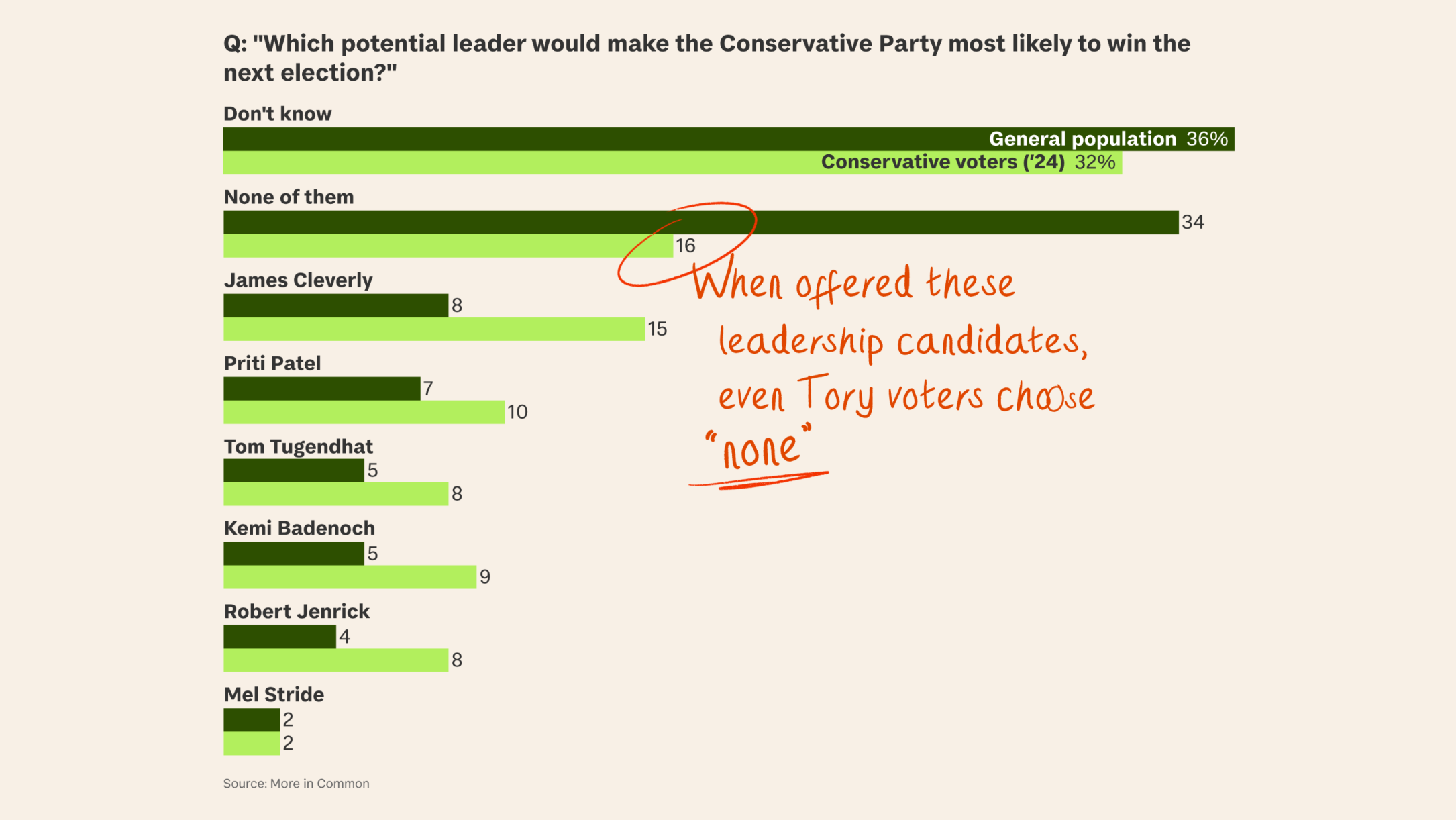
So what? A party that asserted a right to rule for more than 200 years is fighting irrelevance. Its abject defeat on 4 July left voter enthusiasm at a nadir. A poll on Monday found that 70 per cent either didn’t know about the leadership candidates or thought none could win a general election. And yet one of them will try – which is one reason this contest is consequential. Others include
- the shape of British politics, because the next Tory leader could cauterise the rising populist right within the party, or end up enabling it;
- the tone of public discourse, which the winner could poison or enhance; and
- the health of British democracy, which demands a competent opposition.
Contenders. The centre ground is being claimed by James Cleverly, a former home secretary who says he’d scrap stamp duty if he could; Tom Tugendhat, a former security minister and soldier who’s apologised for recent Tory governments; and Mel Stride, a former work and pensions secretary likely to be voted out of the contest today.
Would-be standard-bears of the right, all former secretaries of state, are Robert Jenrick, who’s called for the Home Office to be broken up; Priti Patel, who launched the scheme to deport asylum seekers to Rwanda; and Kemi Badenoch, who likes to remind people she’s an engineer.
Frontrunners. For now they’re Jenrick and Badenoch, but the field is wide. So is the range of issues on which they contrive to disagree, although one dominates.
Immigration. At the start of July, 67 per cent of Conservative voters (to only 18 per cent of Labour’s) ranked immigration and asylum as the most important challenges facing the country. Two months on, they still preoccupy the party.
- Jenrick, who resigned as immigration minister because, he said, the Rwanda scheme didn’t go far enough, says he’d leave the European Convention on Human Rights to control Britain’s borders.
- Tugendhat has flirted with quitting the ECHR but most others say it wouldn’t address the problem – which is true. Most UK immigration is legal and wouldn’t be referred to the court that enforces the convention.
Business and the economy. Badenoch was business secretary but barely talked about it at her launch on Monday. Cleverly did, vowing to cut taxes and spending and restate the case for capitalism. He and Tugendhat tried to claim the mantle of Thatcherism, talking up deregulation as a way to spark growth.
Defence. Tugendhat and Cleverly also shared a promise to raise defence spending to 3 per cent of GDP, though how it would be paid for was left to the imagination.
Health. Polling suggests the NHS is at least as much of a concern as immigration for voters overall, yet it was hardly mentioned at the various launch events.
So what did Badenoch talk about? “Hard truths” and herself. She wants to lean into the culture wars. Her launch was less about policies than a vision she calls “Renewal 2030” – that is, after the next election.
Reform. The Conservatives’ vote share on 4 July fell by 20 percentage points compared with 2019. Reform, now led by Nigel Farage, ate up much of that, winning 15 per cent of the popular vote. Farage has not been mentioned much by name this week, but he has been on everybody’s minds.
Up next. As things stand, the next Tory leader will be named on 2 November after a final vote by the whole membership. There are mutterings that the process could be shortened, though – Labour’s first Budget is scheduled for 30 October.
Does any of this matter? Absolutely. Even though the Conservatives lost 250 seats, they’re still the opposition in what’s still broadly a two-party system – and therefore a vital check on executive power.
What’s more… Even though voters tend to agree with the suggestion that they’ve started to be seen as “weird”, they’ve been called worse.