Liberal Democrats have been celebrating their biggest ever electoral victory at their party conference in Brighton.
So what? It’s not just a celebration. With 72 MPs and the Conservatives still in disarray, the Lib Dems want to be thought of as the real opposition to the Labour government.
Seriously? Yes, the party of Ed Davey, who spent June campaigning by falling off paddleboards.
The argument. A good part of it rests on Sir Ed, who deployed a twin-track campaign strategy of water-based pranks combined with the sensitive telling of his personal story as carer for a son with special needs. It worked, simultaneously ensuring local media coverage, regular national picture stories and public consciousness cut-through. Some colleagues were initially sceptical; now they praise him.
In addition the Lib Dems boast
- more MPs than at any time since 1923;
- three select committee chairs, two of whom have taken on policy areas of vital importance to the party and voters (sewage and social care), presenting an opportunity for genuine influence;
- a unified election campaign that has returned a (relatively) unified cohort of MPs; and
- a claim on the political centre ground, left vacant by the two right-wing frontrunners in the Tory leadership contest, Robert Jenrick and Kemi Badenoch.
There’s even talk in Brighton of using the party’s 72 seats as a bridgehead from which to build. As one MP put it: “If Jenrick wins, we will be delighted, if it’s Kemi we will be ecstatic.”
Have we been here before? In a sense. Lib Dem votes are often protests against the two main parties, and Lib Dem MPs are often shed as quickly as they’re gained, especially if divided on priorities – as in the party’s collapse in coalition, from 57 in 2010 to 8 in 2015.
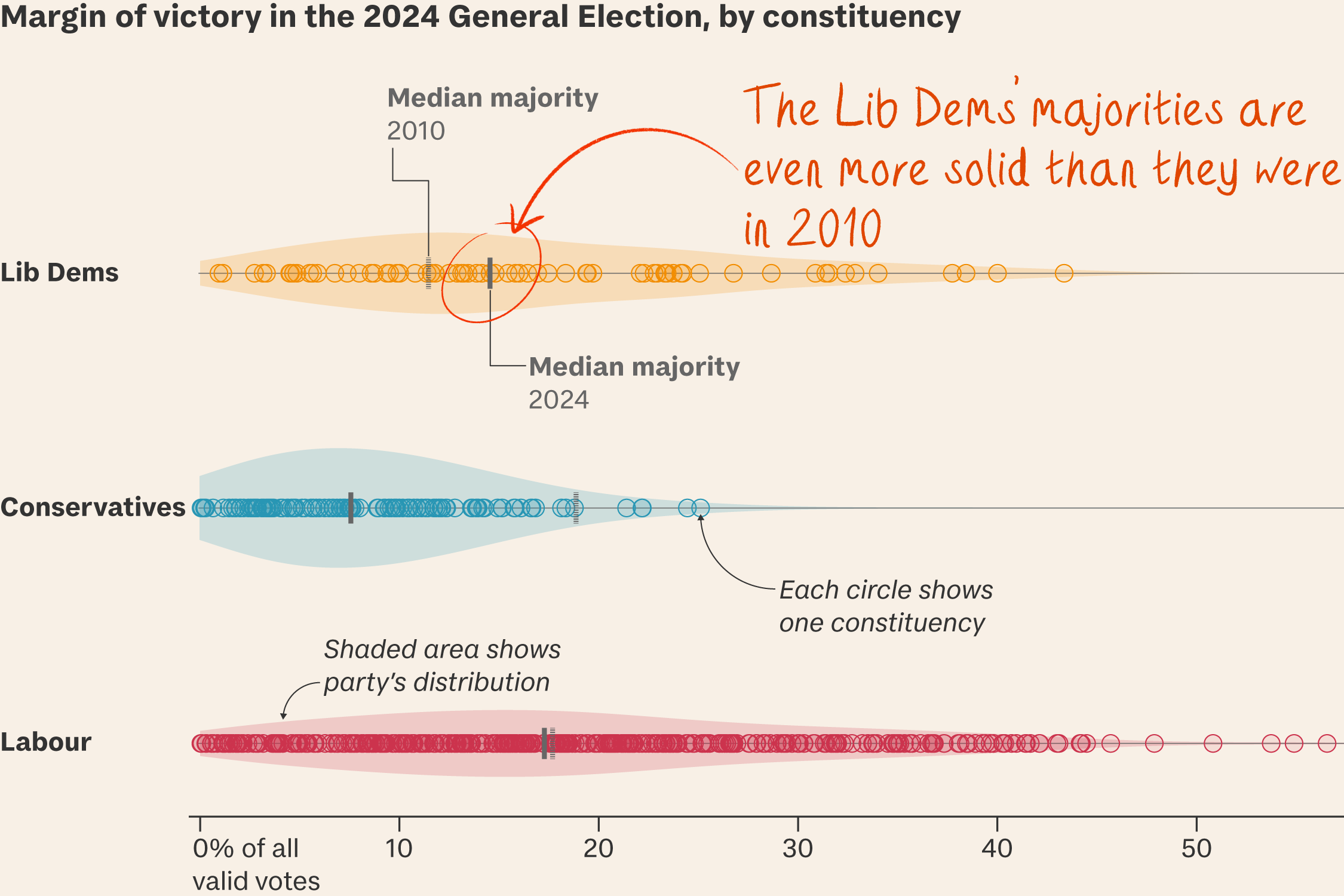
And yet this time the party’s median constituency majority is substantially higher than the Conservatives’ (see graphic) and higher their own in previous elections.
Profile. Having returned from the wilderness to their traditional position as the third biggest party in the Commons, the Lib Dems now get more questions at Prime Minister’s Questions than during the past five years, and more prominence at set-piece events such as the Budget.
Pulpit. Parliament at least is taking them seriously: at Davey’s behest, his chief whip successfully negotiated Lib Dem chairmanships of both the health and social care committee and the environment, food and rural affairs committee. As a result, the party will have a prominent voice in Westminster and beyond on
- social care reform
- sewage and the country’s crisis-stricken water companies, and
- some of the more pressing EU issues, such as a veterinary agreement
The Lib Dems will also have a regular seat on the liaison committee, offering a rare opportunity to grill the prime minister directly. As one MP put it, this is “a good way to get noticed”.
Noticed, that is, for good or ill. There’s plenty that could turn the party on itself.
Brexit. Lib Dem MPs are broadly united on Brexit; activists less so. A show of hands in the conference hall on whether rank and file members want to rejoin the EU suggested they want to move faster than their leaders on Europe, despite clear concerns that the wider public isn’t ready.
Planning. House-building could be contentious for a party seeking to appeal simultaneously to Nimbys and younger voters. A surprise rebellion by Young Liberals at last year’s conference was on precisely this issue.
Being different. The Lib Dems agree with Labour on the need for new homes and much else, but they’re conscious that appearing too cosy with the government has ended badly for them in the past. Tim Farron, who led the party at its lowest ebb, told delegates to limit their celebrations and focus on holding the government to account.
A colleague put it more starkly: “If you fly with the crows, you tend to get shot.”