
Politicians puzzled by the UK’s productivity crisis should take a look at businesses’ energy metres
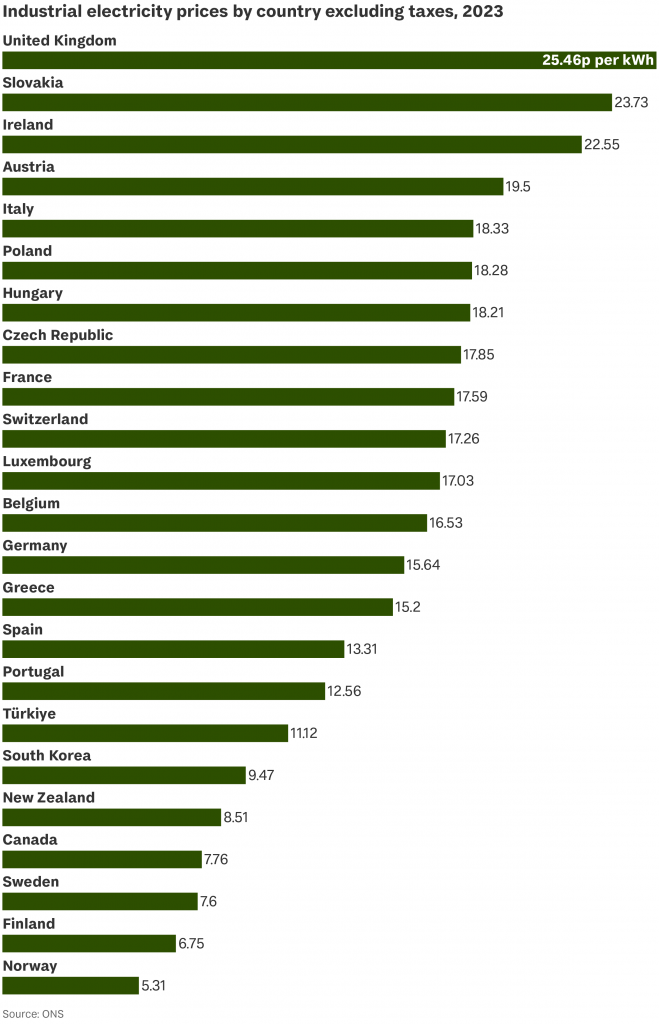
The UK has the highest industrial electricity costs of any country in the developed world, according to recent government data. Even before the invasion of Ukraine, the largest UK businesses were paying 118 per cent more for electricity than their equivalents in France.
So what? Politicians puzzled by the UK’s productivity crisis should take a look at businesses’ energy metres. High costs are hobbling growth across the economy in sectors such as
- Heavy industry. This week the UK’s largest steelworks at Port Talbot shut down in order to replace its 100 year-old blast furnace. Its owner, Tata Steel, has warned that lower electricity prices are critical to its plan to produce green steel by 2028, when it moves to a fully electric arc furnace.
- SMEs. More than half of small business owners are concerned about energy costs rising in the next five years. Research by Cornwall Insight forecasts large retailers and small manufacturers will pay an average of £540,844 per year in 2024-25, close to a £200,000 increase since 2018-19.
- Data centres. Even if Britain wanted to bid adieu to its industrial past (the UK’s last coal mine closed this week) new energy-hungry industries are coming. Large data centres, essential if the UK wants a slice of the AI pie, can require as much power as 300,000 homes and last year accounted for 21 per cent of Ireland’s energy use.
Households may notice their bills go up this week due to a ten per cent rise in the energy price cap. No such limit exists for businesses. Instead the government exempts certain energy-intensive industries like metals or chemicals from having to pay low-carbon levies. But it’s a sticking plaster solution.
How did we get here? Foundations, a 15,000-word policy essay that’s been circulating in Westminster, offers a simple diagnosis: it’s near impossible to build anything in Britain, including energy infrastructure. By the numbers:
- 32 – years since a new reservoir was built in the UK.
- 360,000 – pages of planning documents required for the Lower Thames Crossing, a proposed tunnel connecting Kent and Essex.
- £396 million – cost of HS2, equivalent to eight times more per mile than the high speed link between Tours and Bordeaux.
- 1995 – the last time the UK completed a new nuclear power plant.
Missing nukes. The industrial price of electricity in the UK rose by 153 percent between 2004 and 2021, adjusted for inflation. The authors of Foundations say a failure to keep up with neighbouring countries’ building of nuclear reactors is chiefly to blame.
In 1965, the UK had more nuclear reactors than the rest of the world combined. But a sclerotic, case-by-case planning system has slowed the development of new reactors. For comparison, South Korea builds reactors in “fleets” of 8-12 units and as a result is building them at a quarter the price of Hinkley Point C in Somerset. Always-on nuclear power provides two-thirds of France’s electricity.
It’s the energy, stupid. Historically, it’s been the UK’s ability to produce energy cheaply that has yielded the biggest leaps in productivity, the obvious case in point being coal’s impact in the 18th century. But Britain’s energy use per unit of GDP is now the lowest in the G7, and its domestic sources of fossilised energy in the North Sea are becoming increasingly expensive to extract.
A renewables rollout supported by a backbone of nuclear energy is the answer. The new partnership between Labour’s GB Energy and the Crown Estate – the owner of Britain’s seabed – could be an ideal platform for economies of scale in offshore wind. The much larger challenge is grid capacity. Building in the UK’s own backyard is the way to solve it.